
Quick Summary
If you have ever sent Bitcoin and watched your transaction sit 'unconfirmed' for hours, you have seen the mempool in action. Here is what you need to know:
- The mempool is a temporary holding area for pending transactions before they are added to the blockchain.
- It acts like a decentralized waiting line where miners decide which transactions to process based on fees.
- High network traffic causes 'congestion,' raising fees and delaying confirmations.
- Tools like mempool.space help users track this activity and set competitive fees.
- You can fix stuck transactions using methods like Replace-By-Fee (RBF).
The Invisible Traffic Jam You Pay For
You probably think about money when you buy coffee. But when you send Bitcoin, you are actually participating in a complex global coordination system. The engine that drives this system isn't just the ledger itself; it is the mechanism that sorts requests before they ever become permanent records. That mechanism is called the Mempool, short for memory pool or transaction pool.
Imagine a crowded supermarket checkout. There is only one cashier (the miner), but there are dozens of people with full carts wanting to pay. Nobody knows exactly when they will get served, so some people put cash in their hands shouting "I'm here!", and others quietly wait at the back. The area where everyone stands before paying is the mempool. In the world of cryptocurrencies, this isn't a physical space; it is digital storage held on thousands of computers worldwide.
This concept dates back to the very beginning of digital currency. When Satoshi Nakamoto wrote the original specifications for Bitcoina decentralized digital currency created in 2009, the mempool was built into the foundation. It is not something that came later as an afterthought. It serves as the essential buffer between when you click 'send' on your wallet and when that transaction becomes part of the official history on the blockchain.
How the Mempool Actually Functions
To understand the value of this system, we have to look at what happens under the hood. It isn't magic; it is software logic running on independent computers called nodes. When you initiate a transfer, your wallet creates a cryptographic package containing your digital signature and the destination address. This package is broadcasted to the peer-to-peer network.
Every node receiving this package performs a sanity check. They verify that you own the coins being sent and that you haven't already spent them elsewhere. If everything checks out mathematically, the node adds the transaction to its local mempool. This step happens in milliseconds. However, because each node runs independently, your node's version of the mempool might differ slightly from another person's. One might see a transaction earlier than another due to internet latency.
This distributed nature creates the security guarantee of the network. Unlike a centralized server where one company controls the queue, here the queue is replicated across the globe. No single administrator can delete your request. Instead, the competition comes from other users. Since block space is limited-for example, Bitcoin blocks can only hold about 1 megabyte of transaction data-only some transactions fit in every batch.
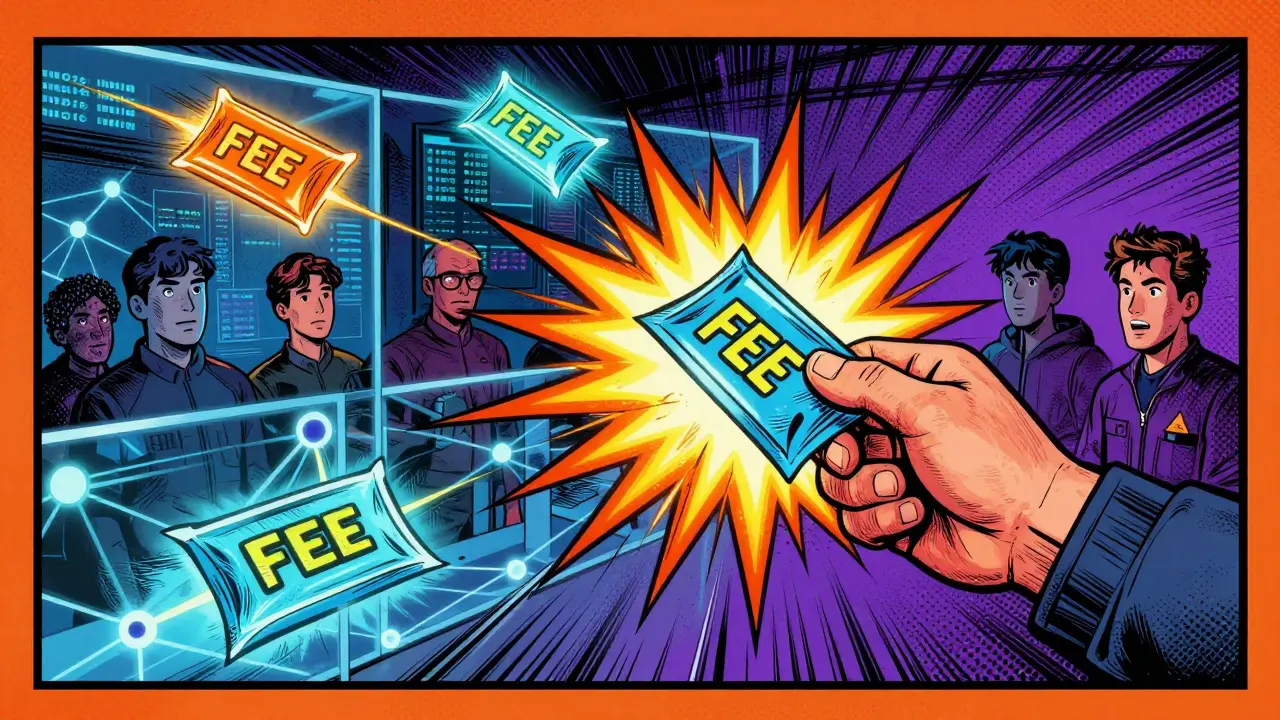
Miners scan these pools to find the most profitable work. They aren't paid by a subscription fee; they are paid by the transaction fees attached to your request. This creates a natural auction system. If you want priority, you attach a higher fee. If you don't mind waiting, you can bid less. This market dynamic ensures that the network remains active even during slow periods, keeping miners incentivized to secure the chain.
The Economics of Block Space
Why do fees change so dramatically? The answer lies in supply and demand. During quiet times, the demand for space is low, and fees drop to the bare minimum required by protocol rules, often just 1 sat/vB (satoshis per virtual byte). But during high-traffic events, the picture changes drastically.
Consider the periods when new features launch or when major markets crash. Suddenly, everyone wants to move funds at once. The mempool fills up. A few years ago, a spike in activity caused fees on Ethereuma blockchain platform supporting smart contracts to skyrocket to nearly $50 for a standard transfer. On Bitcoin, it can mean waiting hours instead of minutes. This isn't arbitrary; it is a reflection of the value placed on speed in a constrained environment.
| Network | Avg Block Time | Typical Fee Unit | Congestion Impact |
|---|---|---|---|
| Bitcoin | 10 Minutes | sat/vB | Fees spike rapidly; backlog grows linearly |
| Ethereum | ~12 Seconds | Gwei | Fees highly volatile; rapid clearance |
| Solana | ~400ms | Lamports | Minimal impact due to high throughput |
Notice the table above. Different networks handle congestion differently. Bitcoin is slower and prioritizes stability, leading to longer waits during spikes. Faster networks try to clear the pool more quickly, but their economic models differ. Understanding these metrics helps you predict costs. When the mempool is empty, you save money. When it is full, you spend more to move faster.
Tools for Navigating the Queue
You do not need to be a computer scientist to manage this. Several browser-based services visualize this data in real-time. The most prominent tool currently is mempool.spacea public mempool explorer launched by Jack Mallers. This platform shows you the exact size of the pending pool, allowing you to estimate how long your transaction will take.
Look for charts showing the distribution of fee tiers. Green usually means immediate confirmation, yellow takes about an hour, and red could take days. Smart wallets integrate this data automatically. If you use a hardware device or mobile app, they often ask, "How fast do you want to send?" Behind that simple question is a live calculation of the current mempool density.
Advanced users also utilize Replace-By-Fee (RBF). This is a protocol rule in Bitcoin that allows you to submit a replacement transaction with a higher fee before the original is confirmed. It essentially says, "Ignore my previous request, here is the same payment with a better tip." About 89% of modern Bitcoin wallets support this feature now, which gives you a safety net if you accidentally bid too low.

Security Risks and Attacks
The open nature of the mempool does introduce vulnerabilities. Since anyone can see pending transactions, it is possible for sophisticated actors to analyze the queue. This creates a risk known as front-running. If you submit a large trade, a bot might spot it in the mempool and attempt to execute a similar trade milliseconds before yours to capture the profit margin.
There are also denial-of-service risks. In theory, someone could flood the network with thousands of junk transactions clogging up the mempool on specific nodes. Researchers at MIT and Cornell have published papers detailing how 'mempool poisoning' attempts try to isolate parts of the network. However, the core design includes eviction policies. Nodes are programmed to drop low-value spam when memory limits are reached, usually protecting the system from total failure.
Privacy tools like CoinJoin mix your transaction with others to make it harder to trace in the pool. As the technology evolves, the balance between transparency and privacy continues to shift. While the ledger is transparent, the path your coin takes through the mempool is becoming more obfuscated to protect user anonymity.
The Future of Transaction Processing
As the number of daily users grows, mainnet mempools will naturally face more strain. The solution isn't necessarily removing them; it is layering efficiency on top. Solutions like the Lightning Network allow for instant payments without touching the main mempool at all. These Layer 2 protocols settle off-chain until a final batch is submitted.
Upgrades like SegWit have already made transactions smaller in size, fitting more into a single block. Newer proposals aim to further optimize how fee data is stored. The goal for developers in 2026 and beyond is to maintain the decentralization security guarantees while reducing the friction of waiting in the line. Whether through sharding, parallel processing, or advanced batching, the mempool remains the bridge between user intent and network reality.
Frequently Asked Questions
What causes transactions to get stuck in the mempool?
Transactions get stuck primarily when the fee you attached is lower than the market rate for that moment. Miners prioritize transactions with higher fees because they want to maximize their earnings. If you pay the bare minimum during a busy period, your transaction sits in the pool waiting for the network to quiet down so miners accept lower bidders.
Can I cancel a pending transaction?
You cannot technically 'delete' a broadcasted transaction. Once a node sees it, it propagates it. However, you can replace it using RBF (Replace-By-Fee) if your wallet supports it. Alternatively, sending a duplicate transaction with significantly higher fees that consumes the same input often forces the network to accept the new one instead.
Is the mempool public?
Yes, the mempool is completely public. Any transaction waiting for confirmation can be viewed by anyone on the network. This transparency is vital for security, ensuring everyone agrees on the pending order of payments, but it does mean your financial movements are visible before they are permanently recorded.
Do altcoins have a mempool?
Most blockchains operate similarly to Bitcoin and have a form of a transaction pool, often referred to as the 'mem' or 'pending queue'. While terminology varies, the function remains the same: sorting and holding requests before block creation. Some high-throughput chains like Solana clear this queue almost instantly, making the delay negligible.
Does the mempool affect my privacy?
It can impact privacy because your transaction is visible in the queue before confirmation. Analyzing the pool can reveal your wallet address and the timing of your transfers. To improve privacy, users often use mixing services or Lightning Network channels which bypass the public mempool for settlement.


Emily 2231
April 2, 2026 AT 01:59I suspect this whole mempool thing is a backdoor for the elites to track our movements before confirmation even happens.
Their so-called transparent system hides the real agenda behind the code.
We cannot trust these node operators to keep our data safe.
It smells like centralized control disguised as a global network.
They want to know everything before we spend a single satoshi.
Patriots should stay away from this surveillance trap.
shubhu patel
April 3, 2026 AT 08:23The concept of a memory pool really changes how you think about digital ownership when you look at the mechanics involved.
It is fascinating that we trust strangers to hold our transaction requests in a buffer before they become permanent history on the ledger.
Many people panic when they see the yellow status light on the tracker application but it is actually normal behavior for the network to fill up.
I found myself reading through the technical specifications recently and realized that this waiting area is the first line of defense against total network collapse during spikes.
Without this buffer mechanism we would have no way to prioritize urgent payments over background updates.
The economics of the fee market seem harsh at first glance to new users who expect instant service from a banking app.
However seeing miners select work based on price creates a healthy competition that keeps the system running without a central boss.
I remember watching the charts spike last year during the holiday rush and realizing how much demand shifts in a single hour.
It makes sense that tools now exist to help us calculate the right tip amount without guessing wildly into the void.
Privacy remains a significant concern because your pending transaction is visible to anyone monitoring the nodes around the globe.
Front running attacks are scary but at least we have protocols like CoinJoin to mix up the signals slightly before confirmation.
Understanding the difference between Bitcoin slow blocks and Ethereum fast settlement helps manage expectations on timing.
People forget that faster networks often sacrifice decentralization which introduces different kinds of systemic risk to watch out for.
We need to accept that speed costs money in a decentralized world unlike the centralized credit card systems we are used to relying on daily.
I hope everyone learns how to read the explorer graphs because it removes the anxiety of waiting for funds to move freely.
It is ultimately about patience and understanding the architecture rather than blaming the software for taking its sweet time.
Arlen Medina
April 4, 2026 AT 00:22You guys worry too much about foreign servers holding your keys.
American mining farms keep the blockchain secure regardless of these fancy pools.
If we need to pay fees to keep the lights on domestically so be it.
Foreign governments can't touch this data stream anymore.
Just send the cash and stop reading conspiracy blogs about tracking.
June Coleman
April 4, 2026 AT 03:25Oh great another day another fee hike that could buy me actual groceries instead of paying miners to wait.
How cute that they call it economic efficiency while charging premium prices for doing absolutely nothing useful.
Imagine paying ten dollars to transfer fifty cents to a friend just because someone decided to dump NFTs.
I swear the algorithm smiles when I lose money waiting for the green bar to load.
Maybe next time they will invent a free tier for honest people.
sekhar reddy
April 5, 2026 AT 22:13THIS IS THE MOST DRAMATIC WAITING LINE EVER IN HISTORY!!!
Why does my bitcoin sit there staring at me like a broken promise?
I thought digital money meant instant magic not this endless queue of pain.
My fingers are trembling waiting for that blue notification to finally pop up on screen.
Please tell me the miners are not ignoring my desperate plea for movement!!!
Suzanne Robitaille
April 6, 2026 AT 00:52There is something profoundly poetic about the shared silence of millions waiting in this invisible line together.
It reminds us that true value cannot be rushed or forced by impatient hands.
The pool reflects the collective anxiety of our modern digital age beautifully.
We stand united in the dark until the block arrives to reveal our fate.
Patience is indeed the ultimate currency in this economy of trust.
JERRY ORTEGA
April 7, 2026 AT 00:16honestly just set your fee higher and move on dont stress about it
most folks panic over nothing anyway
network clears eventually i always tell the newbies to relax
Brooke Herold
April 7, 2026 AT 16:58I prefer using privacy coins to avoid the visibility issues entirely.
Some cultures view financial transparency as a loss of dignity.
Respecting personal boundaries starts with keeping transaction paths hidden from prying eyes.
Trish Swanson
April 8, 2026 AT 19:44This explanation clears up so much confusion regarding pending transactions!
Bruce Micciulla Agency
April 10, 2026 AT 04:12The inefficiency of this model highlights the fundamental flaw in proof of work systems globally speaking today.
Blockchains waste energy clearing queues that a simple database could handle instantly without all the drama.
Miners game the system constantly to maximize profit margins at the expense of average users.
Fees become arbitrary extortion tactics designed to squeeze maximum value from desperate senders.
The entire mempool architecture seems built on friction rather than fluid transaction flow for the masses.
It is obvious that scalability solutions are merely band-aids applied to a bleeding patient.
We are paying premiums for theoretical security benefits that rarely manifest in real world usage scenarios.
Transaction delays create volatility that undermines the core promise of reliable digital settlement infrastructure everywhere.
No rational business accepts this kind of uncertainty as part of the payment processing chain.
Developers continue to patch legacy problems instead of redesigning the core protocol stack completely.
The result is a fragmented ecosystem where user experience suffers consistently due to poor engineering choices made years ago.
Adriana Gurau
April 10, 2026 AT 11:50Obviously only those of us who understand the math can navigate this mess properly 😒
The commoners struggle while we elite investors just smile at their errors 🙄
Stick to basic wallets or face the consequences of ignorance 💸
Robert Coskrey
April 12, 2026 AT 03:16In terms of formal analysis the throughput limitations are clearly documented in the white paper specifications.
One must observe that latency increases proportionally with transaction volume during peak periods.
Furthermore the economic incentives align with scarcity management principles found in traditional markets.
Users require education regarding the mechanics of fee estimation algorithms before engaging in trades.
System integrity relies upon the assumption that participants act rationally during congestion events.
Suvoranjan Mukherjee
April 14, 2026 AT 00:40From a technical perspective the gas wars on Ethereum demonstrate the urgency here!
Layer 2 rollups are solving the scaling issue by batching off-chain computations efficiently.
We are witnessing a transition to shard-based architectures that will bypass mainnet bottlenecks soon enough.
Congestion is simply a signal that the layer 1 is functioning as intended for settlement security.
Optimistic rollups allow for cheap transfers while inheriting the safety of the parent chain validation.
Joshua Aldrich
April 15, 2026 AT 23:13I get that everyone feels stuck when their transaction is just floating out there in limbo.
Honestly sometimes the delay feels personal like the universe is testing your resolve.
But you are not alone in this waiting room of digital payments.
We should all support each other while we wait for those confirmations.
Even with typos in my post I want you to know its okay.
alex rodea
April 17, 2026 AT 20:25Dont worry so much about the wait time my friend.
Just make sure your fee is good enough to get seen.
Soon you will learn the ropes and everything becomes easier.
You can handle this situation calmly without panicking too much.
Susan Wright
April 18, 2026 AT 19:59Just a friendly reminder that RBF is your best friend if you get stuck.
Most modern wallets support bumping fees without needing to start over.
It saves you money and avoids broadcasting duplicates to the whole network.
I recommend checking mempool.space before sending anything big this week.
Deepak Prusty
April 18, 2026 AT 22:08Mempool pressure directly correlates with transaction backlog size on node hardware.
Satoshis per vB dictates miner selection priority in a linear fashion.
RBF implementation reduces unnecessary broadcast spam significantly.
Fee estimation algorithms rely on historical confirmation probabilities.
Manisha Sharma
April 19, 2026 AT 19:33The current system is designed to punish the little guy for existing in this space.
They charge us for breathing air on the blockchain basically.
I refuse to play by rules written by rich tech bros in silicon valley.
This is class warfare disguised as digital infrastructure maintenance.
Revolutionize the chain or get out of my way with your greed.