
When you hear someone say they turned $500 into $18,000 using crypto leverage, it sounds like magic. But behind that win is a razor-thin edge between profit and total loss. Leverage in crypto trading isn’t just a tool-it’s a force multiplier that can blow up your account faster than you can click "sell."
What Exactly Is Leverage in Crypto Trading?
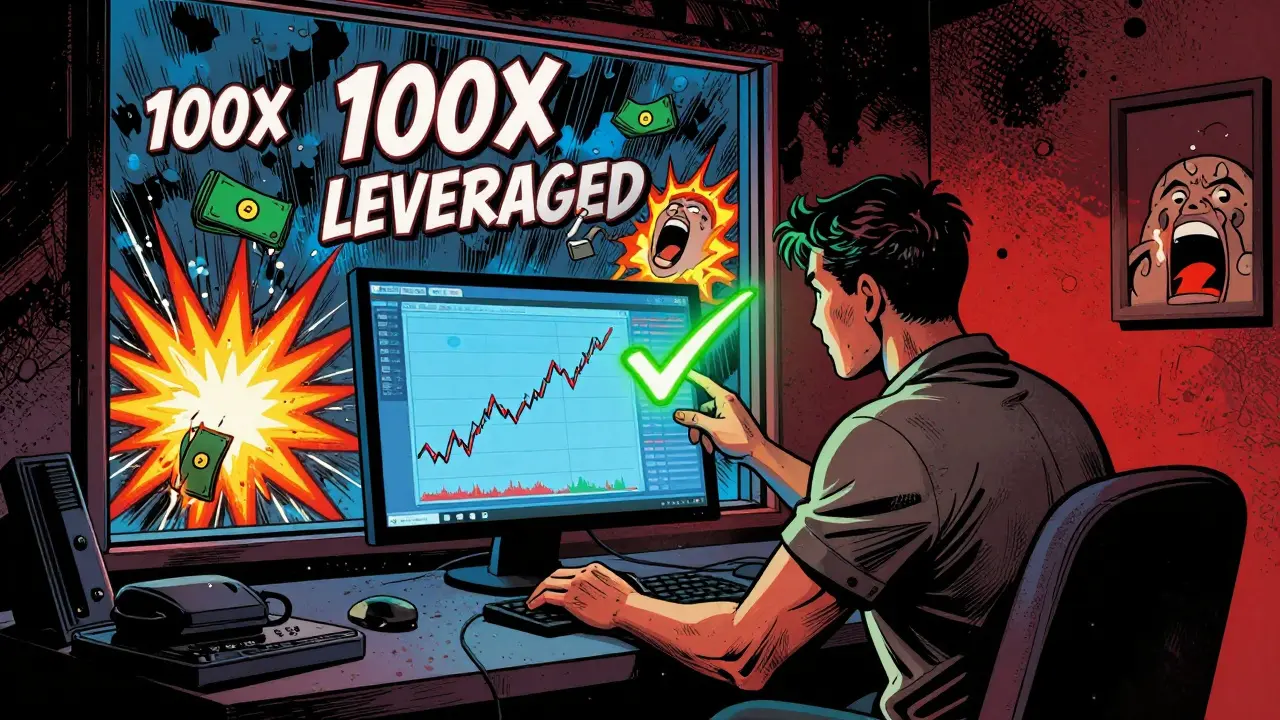
Leverage lets you borrow money from a crypto exchange to control a much larger position than your own funds allow. If you put in $100 and trade with 10x leverage, you’re controlling a $1,000 position. That sounds great-until the market moves $10 against you. Suddenly, you’ve lost your entire $100. And if it moves another $10? You owe the exchange money.
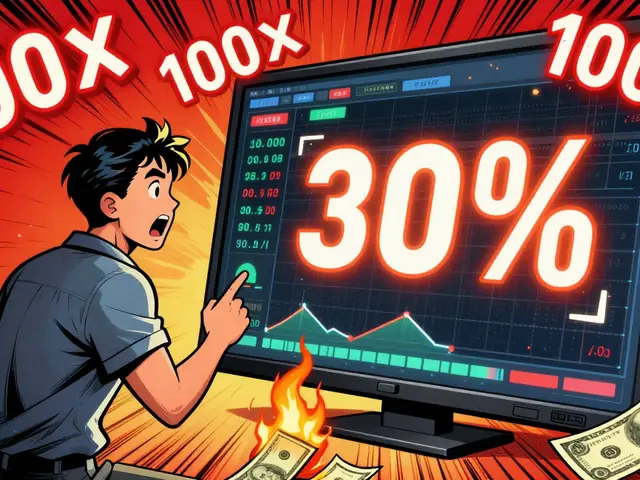
This isn’t theoretical. In May 2021, when Bitcoin dropped 30% in hours, over 85% of open 100x leveraged positions were wiped out across major exchanges. That’s not a bug-it’s how leverage works. The bigger the multiplier, the smaller the price move needed to erase your balance.
How Leverage Works: Margin, Liquidation, and Funding Rates
Three things keep leverage trading from turning into chaos: margin, liquidation, and funding rates.
- Margin is your own money that acts as collateral. At 50x leverage, you only need to put up 2% of the total position. That means for a $5,000 trade, you need $100. But if the value of your position drops below a certain point, you get liquidated.
- Liquidation happens when your losses eat up your margin. Most exchanges set this between 0.5% and 1% below your entry. So if you open a long position at $60,000 with 50x leverage, your liquidation price might be $59,400. One small dip-and poof, you’re gone.
- Funding rates are payments between long and short traders every 8 hours. They keep perpetual contract prices in line with the real Bitcoin price. If funding rates are positive, longs pay shorts. If negative, shorts pay longs. These can add up. A 0.05% rate every 8 hours is 0.15% per day. Over a month, that’s nearly 5% in fees alone.
How Much Leverage Do Exchanges Offer?
Not all exchanges are the same. What’s available depends on where you live and who you’re trading with.
| Exchange | Max Leverage (Retail) | Regulatory Region | Key Feature |
|---|---|---|---|
| Binance | 125x | Non-US | High leverage, complex interface |
| Kraken | 50x | Global | Position size auto-reduces at high leverage |
| Bybit | 100x | Global (non-US) | Liquidation protection via insurance fund |
| Coinbase | 5x | US | Strict compliance, simple UI |
| Bitget | 125x | Global | Partial liquidation system |
In the EU and UK, MiCA regulations cap retail leverage at 2x to 5x. In the US, the SEC has forced platforms to drop from 100x to 25x maximum. But outside those regions, you can still find 100x or even 125x. That doesn’t mean you should use it.

The Real Cost of High Leverage
Here’s the truth most beginners ignore: the higher the leverage, the higher the chance you’ll lose everything.
A 2022 study from the University of California tracked retail traders for six months. Those using leverage above 10x had a 78.3% chance of losing their entire account. Those using 5x or less? Only 42.1% lost everything. That’s not a small difference-it’s a chasm.
And it’s not just about math. In March 2023, during the Silicon Valley Bank collapse, Bitcoin swung 12% in under 90 minutes. Traders on 50x leverage got liquidated in minutes. One Reddit user, CryptoNoob2023, lost $3,500 in 11 minutes. His story got 1,200 upvotes. Not because people were jealous-but because they’d been there too.
Even "smart" traders get burned. A trader on Reddit bragged about turning $500 into $18,000 using 100x leverage. But 97% of the comments were warnings. One replied: "That’s not a strategy. That’s gambling with a lucky streak."
Who Actually Profits from Leverage?
Most retail traders lose. The FCA says 82% of retail CFD traders lose money using leverage. Crypto is no different.
But some win-and they do it the same way professional traders do:
- They use 2x to 5x leverage, never more.
- They set stop-losses at 1-2% below entry.
- They avoid trading during major news events.
- They never risk more than 1-2% of their account on a single trade.
Binance’s own survey found that 68% of profitable leveraged traders used stop-losses religiously. The rest? They were liquidated.
How to Use Leverage Without Getting Wiped Out
If you still want to try leverage, here’s how to do it without becoming a cautionary tale:
- Start with 2x or 3x. You don’t need 50x to make money. A 5% move with 3x leverage gives you 15% profit. That’s enough.
- Never trade with more than 5% of your total balance. If you have $10,000, don’t open a $500 leveraged position unless you’re okay with losing $500.
- Use stop-losses. Set them before you open the trade. Don’t wait. Don’t hope.
- Avoid leverage during high volatility. News, Fed announcements, or Bitcoin ETF decisions? Stay out. The price swings are unpredictable.
- Learn the liquidation price. Know exactly where your position will be closed. If it’s too close to your entry, the trade is too risky.
- Practice first. Use paper trading for 40-60 hours. Kraken recommends this. So do most experienced traders.
The Future of Leverage Trading
Regulators aren’t backing down. The UK’s FCA is pushing for a full ban on retail crypto leverage. The EU’s MiCA rules are already in effect. Even Binance got charged by the CFTC for offering illegal leveraged products to US customers.
Meanwhile, exchanges are adapting. Kraken now has "adaptive leverage" that automatically lowers your position size if volatility spikes. Bybit uses insurance funds to prevent full liquidations during flash crashes. These aren’t kindnesses-they’re survival tactics.
The trend is clear: high leverage is being phased out for regular users. In five years, 50x and 100x will likely be gone from regulated markets. Only accredited investors or institutions will have access.
That’s not a bad thing. It means the market is maturing. Leverage won’t disappear-but it will become a tool for professionals, not a lottery ticket for beginners.
Is Leverage Worth It?
Yes-if you’re disciplined, patient, and risk-aware.
No-if you think it’s a shortcut to riches.
The biggest mistake traders make is thinking leverage makes them smarter. It doesn’t. It just makes losses faster. A 5% move in your favor with 5x leverage feels amazing. A 5% move against you with 5x leverage feels like a punch to the gut.
Most people who use high leverage don’t fail because they’re bad at trading. They fail because they didn’t understand the system. Leverage doesn’t change the market. It changes your psychology. And that’s the hardest part to control.
If you’re new, skip leverage entirely. Learn how the market moves. Master spot trading. Build your confidence. Then, if you still want to try leverage, start with 2x. And never, ever go above 5x.
What does 10x leverage mean in crypto trading?
10x leverage means you can control a position 10 times larger than your own capital. For example, with $100 and 10x leverage, you can open a $1,000 trade. If the price goes up 10%, you make $100 (100% return). But if it drops 10%, you lose your entire $100. The higher the leverage, the smaller the price move needed to wipe you out.
Can you lose more than you invest with crypto leverage?
On most major exchanges, no-you can’t lose more than your initial margin. Platforms use negative balance protection to prevent you from owing money. But some lesser-known or unregulated platforms don’t offer this. Always check the exchange’s terms. If they don’t clearly state they protect against negative balances, avoid them.
Why do exchanges offer 100x leverage if it’s so dangerous?
Exchanges make money from trading fees and funding rates. The more you trade, the more they earn. High leverage attracts traders who are looking for quick wins-and most of them lose. That’s profitable for the exchange, not the trader. It’s a business model built on volume, not user success.
What’s the safest leverage ratio for beginners?
Start with 2x or 3x. This gives you enough amplification to see how leverage affects your trades without putting your entire account at risk. Experts like Michael van de Poppe and Kraken’s educational team recommend never exceeding 5x until you’ve traded spot markets for at least six months and understand volatility patterns.
How do I calculate my liquidation price?
Most exchanges show it automatically on the trade screen. But if you need to calculate it manually: Take your entry price, subtract (or add, for shorts) the maintenance margin percentage. For example, if you go long on Bitcoin at $60,000 with 50x leverage (2% margin), and maintenance margin is 0.5%, your liquidation price is roughly $60,000 x (1 - 0.005) = $59,700. Always double-check your exchange’s exact formula-it varies.
Is leverage trading legal?
Yes, but with heavy restrictions. In the US, EU, and UK, leverage for retail traders is capped at 5x to 25x depending on the jurisdiction. In unregulated markets, higher leverage is available. Always verify your exchange’s compliance with local laws. Using an offshore exchange to bypass leverage limits may violate your country’s financial regulations.
Next Steps: What to Do Now
If you’re thinking about trying leverage:
- Pause. Read one more article. Watch a few educational videos.
- Open a demo account on Kraken or Bybit. Trade with fake money for a week.
- Track your emotions. Did you panic when the price moved $100? Did you ignore your stop-loss?
- If you’re still tempted after that, start with 2x. And stick to it.
If you’ve already lost money with leverage? You’re not alone. The path forward isn’t to double down. It’s to step back. Learn spot trading. Build discipline. Come back to leverage only when you’re ready-not when you’re desperate.
Steven Lefebvre
March 6, 2026 AT 04:35Just started paper trading with 3x leverage after reading this. Feels like riding a bike for the first time-scary but exciting. So far, no liquidations. Just learning how the market breathes.
Still can’t believe how fast 100x traders get erased. It’s not skill, it’s suicide with a chart.
nalini jeyapalan
March 7, 2026 AT 00:32Anyone else notice how every ‘I turned $500 into $18k’ story is followed by 200 comments saying ‘you got lucky’? Yeah, well, luck is just preparation meeting opportunity. Or maybe I’m just delusional.
Either way, I’m using 5x now. No regrets. So far.
Christina Young
March 8, 2026 AT 12:29Leverage isn’t dangerous. People are. You don’t need a 100x explanation-you need a mirror. If you’re asking how to avoid liquidation, you already lost.
Drago Fila
March 9, 2026 AT 22:17Hey, I was right where you are a year ago. Lost my first $2k in a week. Then I stopped. Took 3 months to learn spot trading. Now I use 3x. Not because I’m smart, but because I learned to wait.
And honestly? The wins feel better when you didn’t gamble them.
You got this. Slow and steady wins the race.
Lydia Meier
March 11, 2026 AT 11:56The article is statistically sound, methodologically rigorous, and aligns with empirical findings from the FCA and UC Berkeley studies. However, the presentation lacks formal citations, and the tone is unprofessionally colloquial. This undermines its credibility in academic or institutional contexts.
jay baravkar
March 12, 2026 AT 12:51Bro. I lost $3k in 8 minutes last year with 50x. I cried. Then I deleted the app. Got back in with 2x. Now I make consistent $50-100/day. Not rich. Not broke.
Just… not crying anymore. 😊
Ian Thomas
March 14, 2026 AT 12:29So we’ve established that leverage is a trap designed by exchanges to harvest margin from the overconfident. But here’s the real question: Why do we keep walking into the trap? Is it greed? Or is it just that we all secretly believe we’re the one in 10,000 who’ll beat the odds?
Maybe we’re not traders. Maybe we’re masochists with spreadsheets.
Bryanna Barnett
March 15, 2026 AT 15:11lmao 100x is for chumps. i saw a guy on tiktok use 125x on doge and lost his rent money. he’s now selling his kidneys on ebay. not a joke. i saw the post.
start with 2x. or don’t trade at all. your call.
Josh Moorcroft-Jones
March 17, 2026 AT 09:54While the article presents a compelling narrative regarding the statistical likelihood of retail trader failure under high-leverage conditions, it fails to adequately address the counterargument that institutional-grade risk management systems-when properly implemented-can mitigate the inherent volatility of leveraged positions. Furthermore, the omission of data on professional hedge fund utilization of 20x-50x leverage in arbitrage strategies creates a misleadingly skewed perception. The correlation between leverage ratio and account wipeout does not account for position sizing discipline, which, in my 12-year trading career, has proven to be the sole determinant of long-term survival. Additionally, the article’s dismissal of funding rate arbitrage as merely a ‘fee’ is a gross oversimplification; in fact, it represents a structural revenue stream that can be systematically exploited by algorithmic traders with latency advantages. I’ve personally generated 18% monthly returns using 30x leverage with dynamic stop-losses and delta-neutral hedging. The problem isn’t leverage-it’s incompetence disguised as ‘caution.’
Nash Tree Service
March 17, 2026 AT 22:21I appreciate the thoroughness of this piece. It’s rare to see such a balanced view on leverage. I’ve been trading since 2017. I’ve seen bull runs, crashes, and everything in between. The one constant? The ones who last are the ones who respect the market-not the ones who try to dominate it.
Leaving this here for the next person who thinks they’re ‘different.’ You’re not.
Jane Darrah
March 18, 2026 AT 10:20okay so like… i lost everything in may 2021. like, everything. my laptop, my cat’s vet bills, my grandma’s wedding ring (don’t ask).
but then i got back up. and now i trade 5x. and i cry less. and i still have my cat.
is that a win? idk. but i’m alive. and that counts. right?
…right??
jack carr
March 19, 2026 AT 03:28Been here. Done that. Now I just watch. Sometimes I cheer. Sometimes I cringe.
But I never trade with more than 2x anymore. Peaceful life, peaceful wallet.
Also, Kraken’s paper trading mode is a godsend. Try it. You’ll thank me later.
Eva Gupta
March 19, 2026 AT 10:15I come from India, where leverage trading is still new to most. But I’ve seen friends lose their entire savings chasing 100x dreams.
One of them now works at a call center. Another is studying accounting to rebuild.
This article? It’s not just advice. It’s a lifeline.
Thank you for writing this. I’m sharing it with everyone I know.
Ken Kemp
March 19, 2026 AT 21:02Just wanna say-stop-losses aren’t optional. I set mine religiously. Even on 2x. One time I forgot. Price dipped 3%. I lost 6%. That’s not leverage. That’s just dumb.
Now I double-check. Always. Also, typo: ‘maintenance margin’ not ‘maintanence’-fixed it in my notes. 😅
prasanna tripathy
March 21, 2026 AT 11:24Back home in India, my uncle says crypto is gambling. I said, ‘No, uncle. It’s math.’
He laughed. Then I showed him how 3x with stop-losses made me 12% in a month.
Now he checks my trades every morning. With chai.
Not everyone needs leverage. But those who do? They need discipline. And a good cup of tea.
James Burke
March 22, 2026 AT 22:48Biggest thing I learned? Leverage doesn’t make you rich. It makes you aware of how little control you really have.
Now I trade small. I sleep well. And I don’t check my phone at 3am.
That’s the real win.
Jonathan Chretien
March 23, 2026 AT 22:54Let’s be real. Leverage is the casino’s way of saying ‘I believe in you.’
Then it takes your money.
And laughs.
And buys a yacht.
With your losses.
❤️