
When Bitcoin first appeared in 2009, many believed it would be the ultimate tool for financial privacy. You send money. No bank. No paperwork. No tracking. But within years, it became clear: Bitcoin isn’t private at all. Every transaction is on a public ledger. Every address, every transfer, every timestamp - visible to anyone with a browser. Researchers quickly figured out how to link wallets to real people using simple tricks: timing patterns, address clustering, and transaction graphs. If you buy coffee with Bitcoin on Monday and pay rent with the same wallet on Tuesday, analysts can connect the dots. That’s not anonymity. That’s pseudonymity with a big warning label.
How Privacy Coins Fight Back
That’s where privacy coins stepped in. Monero, Zcash, and Dash weren’t just alternatives - they were direct responses to Bitcoin’s transparency. Monero uses ring signatures to mix your transaction with dozens of others, making it impossible to tell who sent what. It hides the sender, the receiver, and even the amount using something called RingCT. Zcash goes even further with zk-SNARKs - zero-knowledge proofs that let the network verify a transaction is valid without revealing any details. Think of it like proving you’re over 21 without showing your ID. You just say ‘yes’ and the system accepts it.
These aren’t theoretical. Monero processes over 500,000 transactions monthly, and Zcash has over 20% of its supply in shielded (private) addresses. Their goal? Fungibility. Every coin should be worth the same, no matter its history. If you hold a Bitcoin that was once used to buy drugs, some exchanges might freeze it. But a Monero coin? It’s identical to any other. No stigma. No tracking. That’s the core promise of privacy tech: financial freedom, not just freedom from banks.
The Surveillance Counterattack
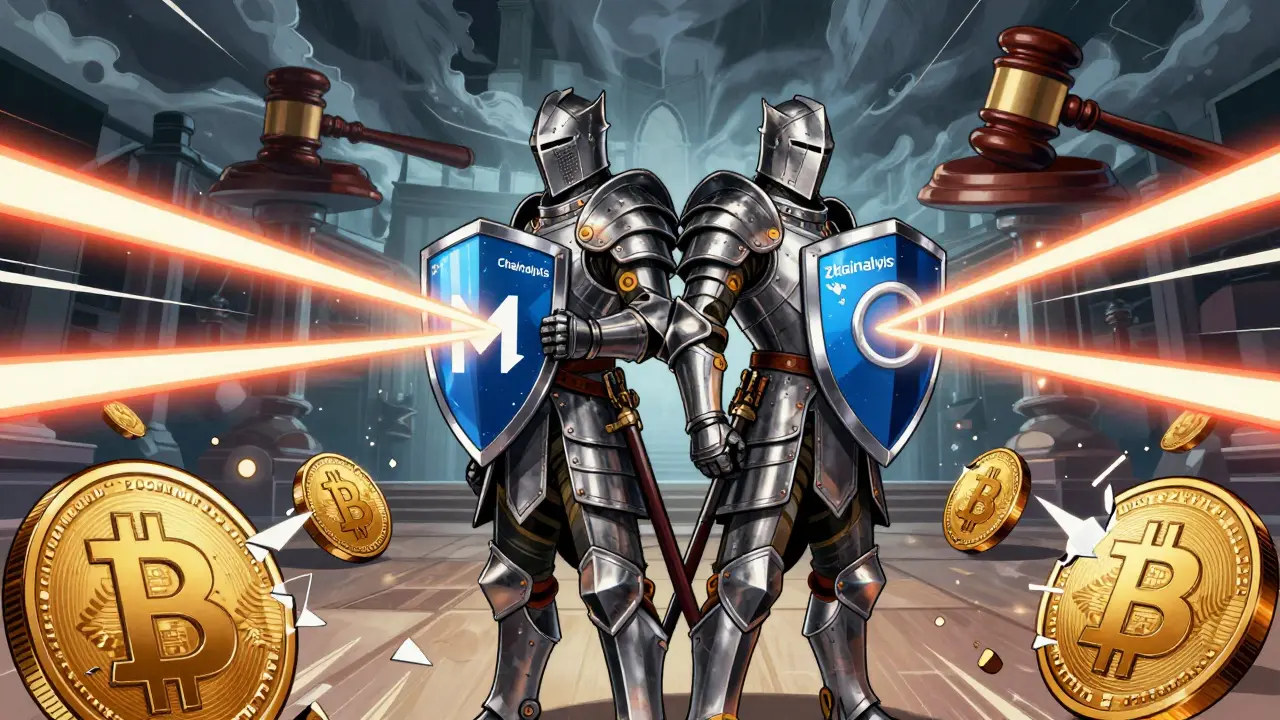
But governments and regulators didn’t sit back. Companies like Chainalysis, Elliptic, and CipherTrace built entire businesses on tracking crypto. They don’t need to crack encryption. They just need patterns. If 100 addresses send money to one wallet at the same time, odds are it’s a mixer or exchange. If a wallet receives funds from a known darknet market and then sends them to a regulated exchange - boom, flag it. These tools use machine learning to spot behavior, not just addresses. They analyze how often wallets interact, how much they hold, when they move funds. It’s digital forensics, but faster and smarter.
The U.S. Department of Justice didn’t just watch - they acted. In 2024, they arrested the founders of Samourai Wallet, a popular privacy tool, for allegedly helping launder over $100 million. The argument? Tools designed for anonymity are inherently dangerous. The defense? Tools designed for privacy are essential for free societies. The court didn’t rule on the ethics - it ruled on licensing. Samourai wasn’t registered as a money service business. That’s the legal trap: if you build privacy tech, you’re now a financial institution - whether you want to be or not.
Regulatory Pressure Is Real
Exchanges feel the heat. Binance, Coinbase, Kraken - they all delisted Monero and Zcash at some point. Why? Because regulators threatened them. If a crypto exchange lets users trade privacy coins, it could be labeled a money laundering hub. The cost of compliance? Millions. The risk? Jail time for executives. So they chose safety over freedom. The result? Privacy coins are now harder to buy, harder to trade, harder to even find on major platforms. In 2025, Monero’s daily trading volume was less than 3% of Bitcoin’s. That’s not because people don’t want privacy - it’s because the system is stacked against it.
Some countries went further. China banned all crypto. Qatar and Saudi Arabia followed. Russia tried to ban it, then backtracked - but still requires all transactions to be reported to the state. The U.S. doesn’t ban privacy coins, but it makes them nearly unusable. If you send Monero to a wallet linked to a U.S. bank, your bank might freeze your account. If you file taxes and mention you own Zcash, the IRS might audit you. It’s not illegal. It’s just terrifying to navigate.
Smart Contracts and the New Battleground
Now, the fight is moving to smart contracts. Ethereum lets you run code on the blockchain - but that code is public. What if you’re running a private business? What if you’re paying suppliers, managing payroll, or handling sensitive contracts? You need privacy, but regulators demand transparency. The solution? Layer-2 privacy protocols. Projects like Aztec and Tornado Cash use zk-rollups to hide transaction details while still proving validity to the main chain. But Tornado Cash got sanctioned by the U.S. Treasury in 2022. Its creator was arrested. The tool still works - but no exchange dares touch it.
Even decentralized finance (DeFi) is caught in the middle. Lending protocols need to know who’s borrowing. But borrowers don’t want their income, assets, or credit history exposed. The tech exists to solve this - zero-knowledge credit scores, private lending pools - but no one dares build them at scale. Why? Because regulators could shut them down overnight.
The Philosophical Divide
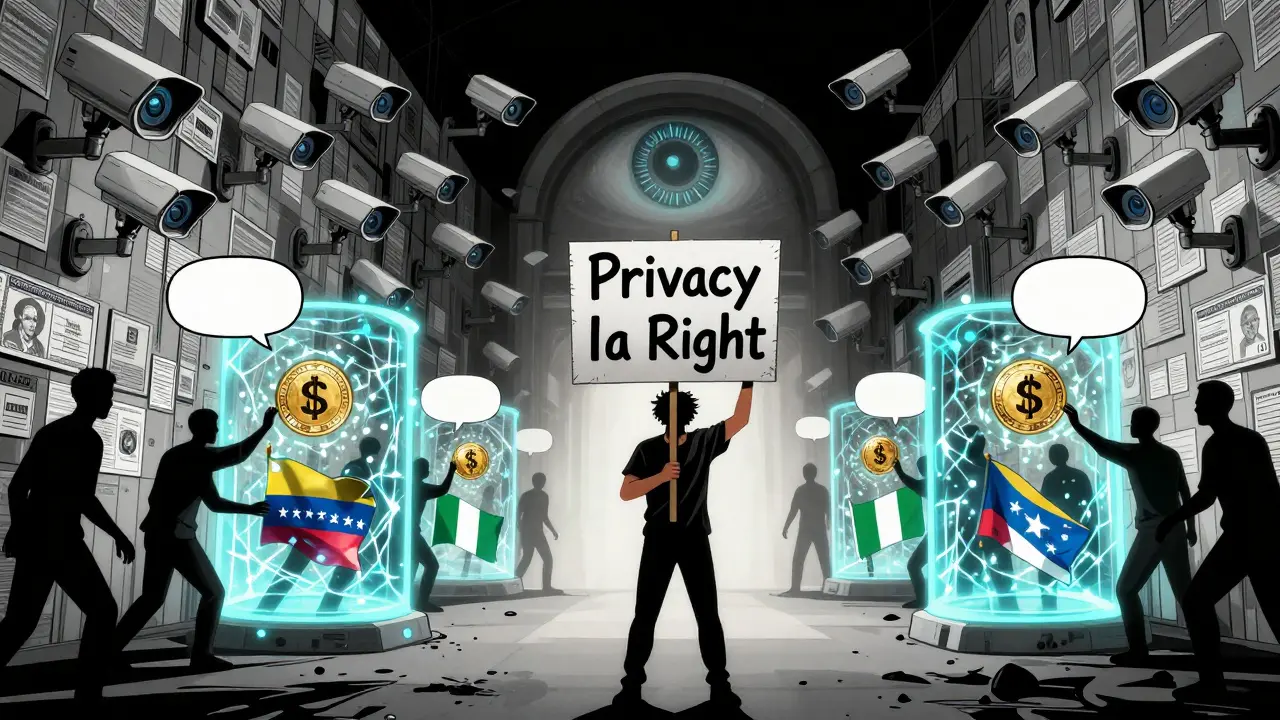
Edward Snowden said it best: “Privacy is not about having something to hide. Privacy is about having something to protect.” That’s the heart of this war. One side sees privacy as a shield for criminals. The other sees it as a shield for citizens. In Venezuela, people use Monero to avoid capital controls. In Nigeria, traders use it to bypass bank freezes. In the U.S., activists use it to protect donors from political targeting. But regulators see only the worst-case scenarios: ransomware gangs, drug cartels, sanctioned entities.
Here’s the truth: privacy tech doesn’t create crime. It makes crime harder to trace. And that’s exactly why it’s feared. Surveillance tech doesn’t stop crime - it just shifts it to places where tracking is harder. The real question isn’t whether privacy is good or bad. It’s: who gets to decide?
The Future: Quantum, AI, and the Next Wave
Both sides are racing toward the next leap. Privacy developers are building quantum-resistant cryptography - algorithms that won’t break when quantum computers arrive. Surveillance firms are training AI to track cross-chain movements. If you send Monero to a Bitcoin mixer, then swap it for Solana, then cash out on a non-KYC exchange - today’s tools struggle. Tomorrow’s AI might not.
Some are trying radical new models. Obyte uses a Directed Acyclic Graph (DAG) instead of a blockchain. No miners. No validators. No central ledger. Just peer-to-peer consensus. It’s censorship-resistant by design. But it’s still tiny - less than $100 million in market cap. The mainstream won’t touch it.
The biggest threat? Regulation that forces privacy into the open. Imagine a world where every crypto wallet must be linked to your ID. Where every transaction must be reported. Where privacy is the exception, not the default. That’s not innovation - it’s control. And it’s already happening.
What This Means for You
If you’re using Bitcoin or Ethereum today, you’re not private. Your transaction history is out there. If you care about financial sovereignty, you need to understand the tools that protect you - and the forces working to remove them. Privacy isn’t about being a criminal. It’s about being human. About having control over your own money. About not needing permission to exist.
The arms race isn’t slowing down. It’s accelerating. And the side that wins won’t be the one with the fanciest tech. It’ll be the one that convinces society that privacy is a right - not a loophole.
Are privacy coins illegal?
No, privacy coins like Monero and Zcash are not illegal in most countries. But many exchanges and financial institutions avoid them due to regulatory pressure. In the U.S., using them isn’t against the law, but failing to report them on taxes or using them with unlicensed services can lead to legal trouble. Some countries, like China and Saudi Arabia, have banned all cryptocurrencies, including privacy coins.
Can Chainalysis track Monero or Zcash?
Chainalysis and similar tools can’t track Monero transactions. Monero’s ring signatures and stealth addresses make it mathematically impossible to trace sender, receiver, or amount. Zcash is trickier - its shielded transactions are private, but its transparent ones are fully visible. Most Zcash users mix both, which makes analysis harder, but not impossible. Chainalysis has no public tool that can break Monero’s privacy.
Why did exchanges delist privacy coins?
Exchanges delisted privacy coins because regulators threatened them with fines, sanctions, or criminal charges if they allowed trading of assets that could be used for money laundering. Coinbase, Binance, and Kraken all removed Monero and Zcash at least once. The risk wasn’t the coins themselves - it was the legal liability. Even if users weren’t breaking laws, regulators assumed the worst.
Can I still use privacy coins today?
Yes, but it’s harder. You can buy Monero and Zcash on smaller exchanges like Bisq, KuCoin, or through peer-to-peer platforms like LocalMonero. You can store them in wallets like Monero GUI or Zcash Shielded Wallet. But you won’t find them on Coinbase or Robinhood. Using them requires more effort - and more awareness of the risks, especially if you’re in a country with strict crypto laws.
Is privacy in crypto a human right?
Legally, no - not yet. But ethically, many argue yes. Financial privacy protects people from surveillance, discrimination, and abuse. In authoritarian regimes, it keeps savings safe. In democratic ones, it prevents government overreach. The U.N. has recognized privacy as a human right in digital spaces. Whether that includes crypto transactions is still being fought in courts and legislatures worldwide.
Brandon Kaufman
March 10, 2026 AT 09:56Anshita Koul
March 10, 2026 AT 19:29Jenni James
March 11, 2026 AT 20:26Chelsea Boonstra
March 12, 2026 AT 06:15Alex Thorn
March 13, 2026 AT 00:49Howard Headlee
March 13, 2026 AT 17:58Anthony Marshall
March 13, 2026 AT 18:22ann neumann
March 15, 2026 AT 06:40William Montgomery
March 16, 2026 AT 21:43Mara Alves Mariano
March 18, 2026 AT 09:47Tom Jewell
March 19, 2026 AT 03:11karan narware
March 19, 2026 AT 13:23Michael Suttle
March 20, 2026 AT 10:01Craig Gregory
March 20, 2026 AT 19:28Douglas Anderson
March 22, 2026 AT 04:30Tina Keller
March 22, 2026 AT 20:04vasantharaj Rajagopal
March 23, 2026 AT 18:23Allison Davis
March 24, 2026 AT 12:48PIYUSH KOTANGALE
March 25, 2026 AT 11:45vishnu mr
March 25, 2026 AT 23:49Grace van Gent-Korver
March 27, 2026 AT 22:02Zephora Zonum
March 28, 2026 AT 10:04Lindsay Girvan
March 30, 2026 AT 03:04Adam Ashworth
March 30, 2026 AT 18:21Sherry Kirkham
March 31, 2026 AT 09:50Sharon Tuck
April 2, 2026 AT 02:12Jennifer Pilot
April 2, 2026 AT 14:44Julie Tomek
April 3, 2026 AT 12:42