When banks in Russia started blocking crypto deposits in 2022, people didn’t stop trading-they just switched to something else. P2P crypto trading became the lifeline. No more waiting for bank approvals. No more frozen accounts. Just direct trades between people, using local payment methods like Sberbank cards, SBP transfers, or Yandex Money. Today, it’s the only way most Russians buy and sell crypto at scale.
Why P2P Is the Only Game in Town
Traditional exchanges like Binance and OKX stopped offering Russian ruble (RUB) trading entirely. No ads. No deposits. No withdrawals. That left a massive gap. Enter P2P platforms: decentralized marketplaces where you trade directly with another person, and the platform acts as a middleman-holding your crypto in escrow until you confirm you got paid. This isn’t just a workaround. It’s the new normal. In October 2025, Bybit processed over $27 million in RUB trades in just 24 hours. That’s more than the entire daily volume of the next three biggest platforms combined. Why? Because it’s built for Russia.Top Platforms for P2P Crypto Trading in Russia (2025)
Here’s who’s still active-and why users are sticking with them.- Bybit: The leader. Over 3,800 active ads. Zero fees on maker orders. Full Russian interface, support, and educational content. You can deposit RUB via Sberbank, Tinkoff, Advcash, and even MIR cards. It supports 2,000+ coins and offers futures, staking, and copy trading. Most Russian traders start here.
- HTX P2P: Solid second place. Over $7.6 million in daily volume. Good selection of altcoins. Supports SBP and bank transfers. Fewer features than Bybit, but reliable.
- MEXC: The altcoin hub. Over 2,800 trading pairs. Zero maker fees. New tokens list within hours of launch. Supports Payeer, Yandex Money, and SBP. Popular with traders chasing early-stage projects. Offers up to 500x leverage on futures.
- KuCoin: 900+ coins. 0.1% trading fees. Only accepts card deposits (no SBP or bank transfers). Still useful if you’re on Tinkoff or Raiffeisenbank.
- Bitget: Got licensed in Bulgaria in early 2025, making it compliant under EU rules. Offers 125x leverage. Low fees when you pay with BGB tokens. Supports card and SBP deposits. Strong copy trading tools.
Notice anything missing? Binance. OKX. Coinbase. All gone. They either pulled out or got blocked. If you see a “Binance P2P RUB” ad, it’s fake. Don’t click it.
How P2P Trading Actually Works
It’s not as simple as sending money and getting crypto. Here’s the real flow:- You buy USDT (Tether) with your bank card or SBP transfer. This is your crypto gateway.
- You go to the P2P marketplace and find a seller offering RUB for USDT.
- The platform holds your USDT in escrow.
- You send RUB to the seller’s bank account using their preferred method.
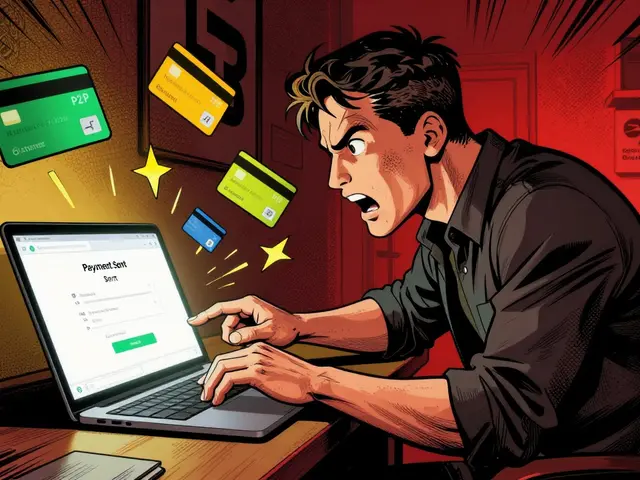
- You click “Payment Sent” and upload proof.
- The seller confirms receipt.
- The platform releases the USDT to your wallet.
It sounds straightforward. But here’s where it gets messy.
The Hidden Language of Russian P2P Payments
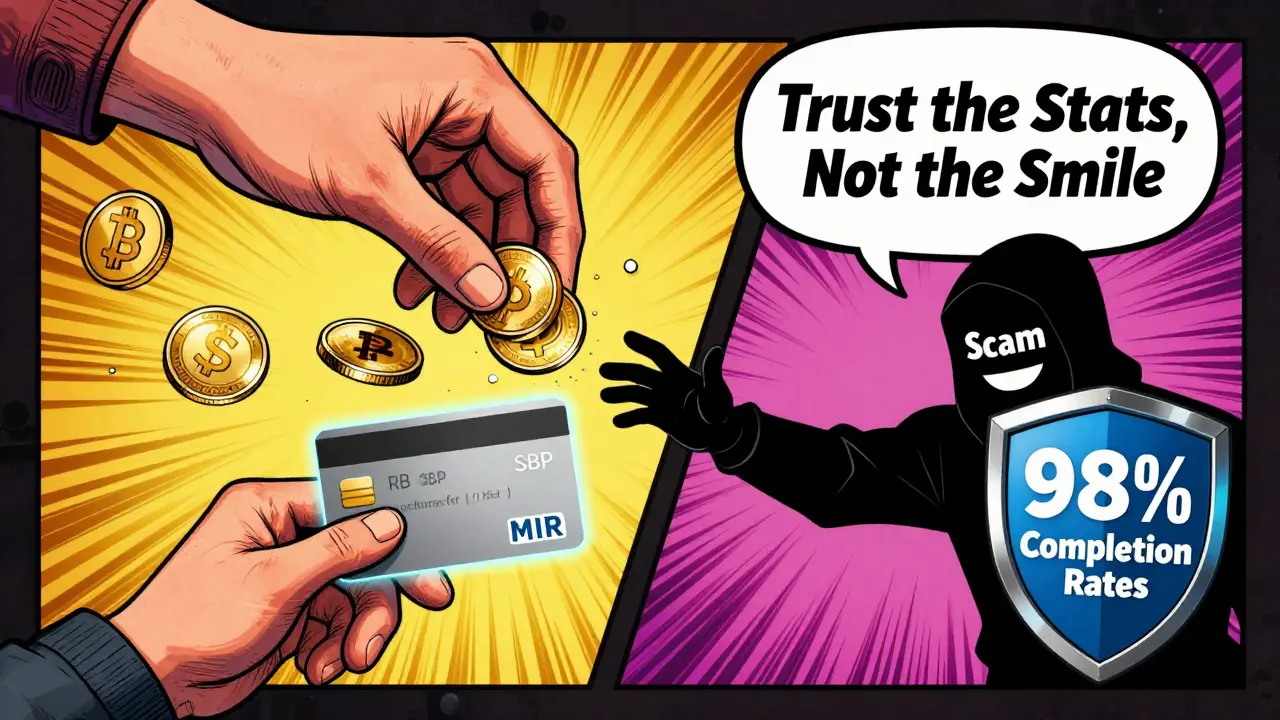
Because of sanctions, platforms can’t use real bank names. So they use colors.- Green Card = Sberbank
- Yellow Card = Tinkoff (now T-Bank)
- Blue Card = Raiffeisenbank
- Red Card = OZON Bank
- Gray Card = MIR card system
Why does this matter? Because if you send money to a “Yellow Card” seller but your bank is Sberbank, the transaction might get flagged. Banks monitor transfers between different institutions. If you’re sending RUB to a Tinkoff account from Sberbank, it looks suspicious. That’s why you need to match your payment method to the seller’s.
Also, never use a third-party account. If the seller asks you to send money to their cousin’s account, walk away. That’s how money laundering schemes start-and you could get your account frozen.
The Real Risks (Not the Theoretical Ones)
Most guides list “price volatility” and “scams” as risks. That’s true-but it’s not what hurts people the most.1. Counterparty Risk: The Silent Killer
You send RUB. The seller claims they never got it. You’re stuck. The platform side with the seller 70% of the time if they’ve got a 98% completion rate and 10,000 trades. Why? Because they’re more likely to be legitimate.Always check:
- Completion rate above 95%
- At least 500+ completed trades
- Recent activity (last 24 hours)
- No negative reviews mentioning “payment not received”
One trader in Kazan lost $1,200 in January 2025 because he trusted a new seller with a 99% rating. The rating was fake. The account was created that morning. The seller vanished after the crypto was released.
2. Bank Account Freezes
Russian banks are watching. If you receive RUB from a P2P crypto trade, your account might get flagged for “suspicious activity.” You’ll get a call from your bank asking, “Why did you receive $5,000 from an unknown person?”Some users get locked out for weeks. Others get fined. The Central Bank hasn’t made it illegal to trade crypto-but it has made it easy for banks to punish you for it.
Solution? Keep transfers under 100,000 RUB per transaction. Use multiple accounts if you can. Never transfer large sums all at once.
3. Platform Risk
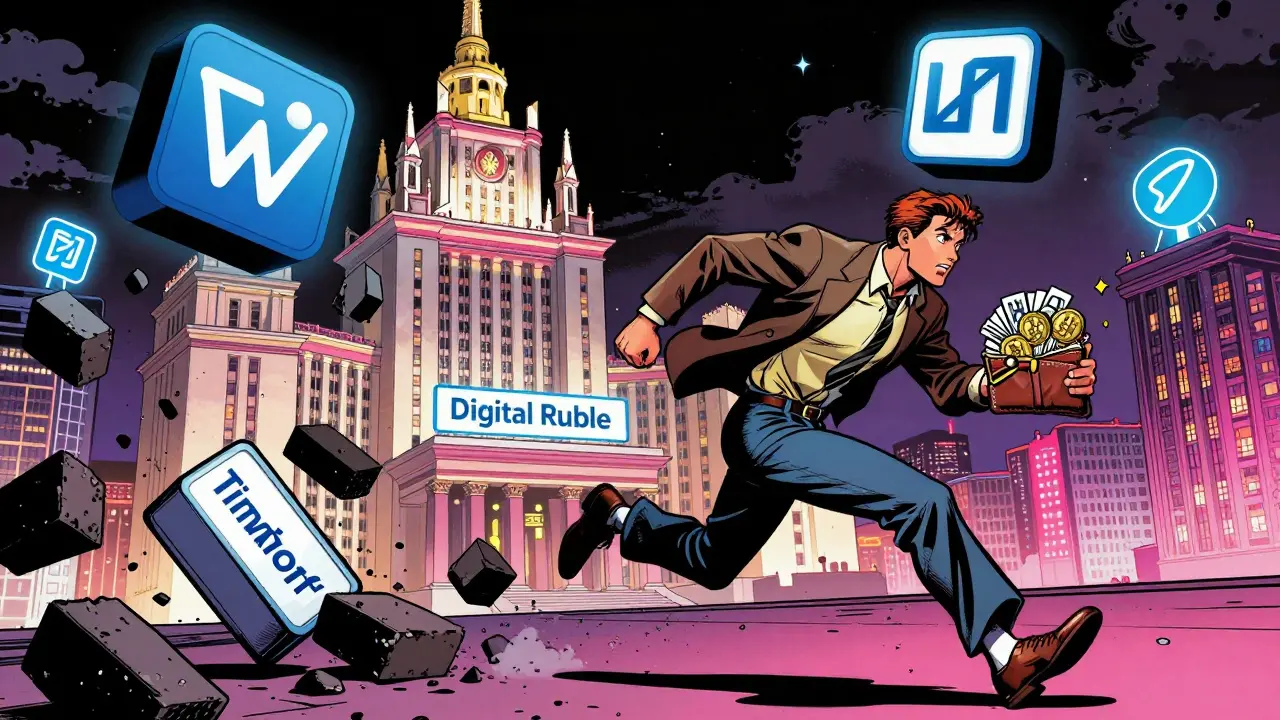
What if Bybit gets blocked tomorrow? What if MEXC’s servers go down during a price spike? What if the platform gets hacked?Platforms are under constant pressure. Russia’s Ministry of Finance has been pushing for a ban on all crypto exchanges since 2024. If they succeed, your funds could vanish overnight. That’s why you should never keep large amounts on exchanges. Move crypto to a non-custodial wallet like Trust Wallet or MetaMask after each trade.
4. Price Slippage
Crypto prices move fast. You agree to trade 1 USDT for 95 RUB. But while you’re waiting for the seller to confirm payment, the price drops to 93 RUB. Now you’ve lost 2%.Use limit orders. Don’t trade during high volatility windows (like after major news or during Russian market open hours). Set your price slightly below market to ensure faster execution.
Security Must-Haves
You wouldn’t leave your house unlocked. Don’t leave your crypto account unprotected.- Enable two-factor authentication (2FA) on every platform. Use an authenticator app-not SMS.
- Never click links in emails or Telegram messages claiming to be from “Bybit Support.” They’re phishing scams.
- Verify the bank account name matches the seller’s profile. If the name says “Ivan Petrov” but the account is under “Oleg Sidorov,” don’t proceed.
- Use a separate email and phone number for crypto trading. Don’t link it to your main accounts.
What’s Next for Russian P2P Crypto?
Platforms are getting smarter. Bybit launched a built-in RUB on-ramp in its wallet app. MEXC is testing instant RUB withdrawals to e-wallets. Bitget added AI-driven fraud detection.More Russians are using DeFi tools now-staking USDT for 8% APY, lending on decentralized protocols, even using crypto as collateral for loans. The ecosystem is evolving beyond simple trading.
But the risks aren’t going away. Regulation is tightening. Banks are getting better at detecting crypto-linked transfers. The government is pushing for state-controlled digital rubles.
For now, P2P trading survives. But it’s a tightrope walk.
Final Advice
- Start small. Trade 5,000 RUB first. Test the process. - Only use platforms with Russian language support and local payment options. - Never trade with someone who won’t accept SBP or card payments. - Withdraw crypto to your own wallet after every trade. - Keep records. Screenshots of chats, payment receipts, transaction IDs. - If something feels off, stop. Walk away.P2P crypto trading in Russia isn’t about getting rich quick. It’s about staying in control when the system tries to lock you out. Do it right, and you can trade safely. Do it careless, and you lose more than money-you lose trust.
Sammy Tam
December 18, 2025 AT 01:58Man, I never thought I'd see a country turn P2P trading into an art form. The color-coded bank system? Brilliant. Like a crypto heist movie but with Sberbank cards and zero drama. I'm half-tempted to open a Russian bank account just to see how this works in practice.
Also, the fact that Bybit does $27M in 24 hours? That's more than some small countries' daily crypto volume. Russia didn't just adapt - they redefined the game.
Kayla Murphy
December 19, 2025 AT 16:04This is the kind of grassroots innovation that gives me hope. When the system tries to shut you down, people just build a better door. P2P isn’t just trading - it’s resilience in action. Keep going, Russian traders. You’re showing the world how to stay free.
Chevy Guy
December 20, 2025 AT 07:40So the government banned crypto but banks are still taking money from people who trade it? Classic. Next they’ll say Bitcoin is a tool of the deep state and start issuing digital rubles with GPS trackers embedded in the blockchain. I told you this was a slippery slope. They’re not banning crypto - they’re just making it a surveillance feature.
Also, why is no one talking about how Bybit is probably a CIA front? They’ve got Russian support? Yeah right. That’s how they get intel.
Amy Copeland
December 21, 2025 AT 10:58How quaint. You people treat P2P like some kind of underground revolution when it’s just financial arbitrage with extra steps. And calling Sberbank a ‘green card’? How adorable. You think you’re clever for codifying sanctions into a color wheel. It’s not ingenuity - it’s desperation dressed up as culture.
Also, 500x leverage on MEXC? That’s not trading. That’s gambling with a PhD in self-destruction.
Sally Valdez
December 21, 2025 AT 20:56Why are we even talking about this? America banned crypto in 2023 and everyone just moved to crypto-friendly countries. Russia’s just playing catch-up with a side of chaos. You think you’re rebels? You’re just the last ones holding the bag while the rest of the world moved to Solana and DeFi.
Also, MIR cards? That’s not innovation. That’s a national ID system with extra fees.
Jonny Cena
December 21, 2025 AT 23:43Big respect to everyone in Russia keeping this alive. This isn’t just about crypto - it’s about keeping your financial autonomy when the system tries to take it away. I’ve seen people lose everything trying to do this, and still they come back. That’s courage.
Start small, trust the process, and always withdraw to your own wallet. You’re not just trading - you’re building a new kind of economy. Keep going.
George Cheetham
December 23, 2025 AT 19:35There’s a philosophical layer here that’s often missed. P2P trading in Russia isn’t just economic adaptation - it’s a reclamation of agency. When institutions fail, individuals become the infrastructure. The color-coded banks? That’s not a workaround - it’s a new language of trust, forged in the absence of institutional legitimacy.
What we’re witnessing isn’t a market. It’s a social contract rewritten in real time.
Emma Sherwood
December 24, 2025 AT 04:59As someone who’s lived in five countries and traded crypto in four, this is one of the most beautifully organic financial ecosystems I’ve ever seen. The way Russians turned restrictions into ritual - the SBP transfers, the color codes, the 24-hour vigilance - it’s like poetry written in blockchain.
And yes, the bank freezes suck. But you know what? They’re still trading. That’s the quietest form of revolution.
Mark Cook
December 25, 2025 AT 11:29lol imagine trusting a 99% rating from a new account 😂
Samantha West
December 26, 2025 AT 12:48It is imperative to note that the structural vulnerabilities inherent in decentralized peer-to-peer financial networks - particularly under conditions of state-sanctioned financial repression - necessitate a rigorous, multi-layered risk mitigation framework. The absence of institutional oversight, coupled with the proliferation of fraudulent seller profiles, constitutes a systemic threat to financial integrity that cannot be mitigated by mere transactional caution.
One must consider the epistemological implications of color-coded banking identifiers as semiotic artifacts of a fractured monetary order. Are we not, in essence, constructing a new lexicon of financial survival - one that renders the state’s regulatory apparatus obsolete through linguistic adaptation?
Craig Nikonov
December 27, 2025 AT 12:41Bybit’s volume is insane but here’s the real story: the platform’s Russian interface is a front. Their backend is in Bulgaria, their servers in Singapore, and their KYC? Nonexistent. They’re not helping Russians - they’re harvesting data on every single transaction. The Central Bank isn’t your enemy. Bybit is.
Also, MIR cards? That’s a state-run payment system. You’re literally funding the regime every time you use one. Wake up.
And don’t get me started on ‘copy trading’. That’s just automated gambling with a Russian accent.
Jesse Messiah
December 28, 2025 AT 22:36hey everyone just wanted to say this is so cool to see how people are making it work despite everything
i know it sounds basic but start with like 5000 rubles and just test it out - dont rush
and always screenshot everything. i learned that the hard way lol
Rebecca Kotnik
December 29, 2025 AT 12:26The emergence of peer-to-peer cryptocurrency trading as a de facto financial infrastructure in the context of systemic monetary isolation represents a profound sociotechnical phenomenon. The transition from institutional banking to decentralized, individualized transactional networks is not merely an economic adaptation - it is a reconfiguration of trust architectures under conditions of institutional collapse.
Moreover, the codification of banking institutions via chromatic identifiers (e.g., green = Sberbank) constitutes a linguistic innovation that mirrors the semiotic strategies of wartime resistance movements. This is not just trading. It is the birth of a crypto-vernacular - a lexicon of survival encoded in color, protocol, and ritual.
One must also consider the temporal dimension: the latency between payment confirmation and crypto release introduces a new form of economic anxiety - a psychological burden borne by traders who must reconcile the volatility of asset value with the uncertainty of counterparty reliability. The human cost here is rarely quantified, yet it is the true metric of this system’s resilience.
Elvis Lam
December 29, 2025 AT 14:41Most people miss the real trick: never use a bank that doesn’t support SBP. Tinkoff and Sberbank are the only ones that won’t freeze you if you’re under 100K per transfer. Also, use a VPN - not because you’re hiding, but because some platforms block Russian IPs even if you’re trading from abroad.
And yes, the 99% rating scam is real. I lost $800 last year. Now I only trade with sellers who have 500+ trades AND posted a selfie holding today’s newspaper. No joke.
Timothy Slazyk
December 30, 2025 AT 07:29This isn’t about crypto. It’s about sovereignty. When your government controls your bank, and your bank controls your money - you don’t need to rebel. You just need to bypass. P2P isn’t a loophole. It’s a new constitution for finance.
And the fact that people are using it to stake USDT at 8%? That’s not speculation. That’s economic self-determination. You’re not trading Bitcoin. You’re building a parallel economy - one transaction at a time.
Bradley Cassidy
December 31, 2025 AT 22:14just tried bybit for the first time yesterday and wow the interface is so smooth like way better than binance used to be
also i thought green card meant something else lmao
Abby Daguindal
January 2, 2026 AT 07:20So you’re telling me Russians are risking account freezes and prison time to trade crypto… while the rest of us are still using PayPal? Pathetic. You’re not brave - you’re just reckless. There’s a reason the world moved on from this. You’re clinging to a dying system.
Patricia Amarante
January 3, 2026 AT 09:22so true about withdrawing to your own wallet. i learned that the hard way.
SeTSUnA Kevin
January 4, 2026 AT 07:37Using MIR cards to fund crypto transactions is a direct subsidy to the Russian state apparatus. Your ‘freedom’ is being monetized by the very entity you seek to circumvent. This is not resistance. It is complicity with a neo-authoritarian financial architecture.
Sean Kerr
January 5, 2026 AT 15:51YESSSS!!! This is exactly what I’ve been saying!!
ALWAYS USE 2FA WITH AUTHENTICATOR APP!!!
NEVER CLICK LINKS FROM “SUPPORT”!!!
AND FOR THE LOVE OF BITCOIN - WITHDRAW TO YOUR WALLET!!! 😭🙏
Florence Maail
January 7, 2026 AT 04:13They’re all lying. This whole thing is a CIA psyop to destabilize the ruble. You think the ‘color codes’ are for traders? Nah. They’re for the NSA to track every single transfer. The Central Bank doesn’t care about you - they’re just letting you dig your own grave with USDT.
Also, who even uses MEXC? That’s a crypto graveyard. I saw a guy lose $20k there last month. He cried on Reddit. I screenshot it. Still got it.
Sue Bumgarner
January 7, 2026 AT 11:58Why are Americans even reading this? Russia’s a dictatorship. You’re helping them trade crypto so they can buy more tanks. This isn’t freedom - it’s funding war. Shut it down. All of it.
Dionne Wilkinson
January 9, 2026 AT 08:14It’s kind of beautiful, isn’t it? People finding a way to trade, to survive, to keep some control. Not because it’s easy. Just because they have to. I wish more people understood that this isn’t about money. It’s about dignity.
Kelsey Stephens
January 10, 2026 AT 21:35Thank you for writing this. I’ve been scared to try P2P but this made me feel like I could. I’m starting with 5000 RUB this weekend. If I mess up, I’ll just learn. You’re right - it’s about staying in control. Not getting rich.
Tom Joyner
January 12, 2026 AT 03:17Most of these platforms are shell companies with offshore servers. The ‘Russian support’ is outsourced to a call center in Bangalore. Don’t flatter yourself. You’re not building a movement. You’re just using a service that doesn’t care if you get frozen.
Donna Goines
January 12, 2026 AT 21:31They’re all being watched. Every click, every transfer, every screenshot. The FSB has bots crawling these platforms. The ‘completion rate’? Fake. The ‘verified sellers’? Paid actors. This whole system is a honeypot. You think you’re trading crypto? You’re feeding data to the Russian state. They’re building your profile. One day, you’ll get a letter. ‘Why did you trade 300,000 RUB in 7 days?’ And you won’t have an answer.
Greg Knapp
January 13, 2026 AT 00:52bro i just sent 100k to a yellow card seller and he ghosted me
now my bank is asking why i sent money to a stranger
why does this always happen to me
im so tired
Shruti Sinha
January 14, 2026 AT 16:28As an Indian trader, I’ve seen similar patterns during demonetization. People found ways. This isn’t unique to Russia. It’s human nature. When institutions fail, communities build alternatives. Respect.
Cheyenne Cotter
January 16, 2026 AT 16:11Let’s be real - the entire P2P ecosystem is built on a foundation of regulatory arbitrage and psychological manipulation. The color-coded bank system is a performative illusion of transparency designed to pacify users into believing they have agency. In reality, you are operating within a closed-loop system where the platform controls the escrow, the bank controls the liquidity, and the state controls the narrative. The only thing you control is your willingness to participate in this elaborate charade.
And yet - and yet - people still do it. Why? Because the alternative is worse. And that, my friends, is the most terrifying truth of all.
Sammy Tam
January 17, 2026 AT 20:41Wait - I just saw a comment below saying Bybit is a CIA front. That’s wild. But if they’re harvesting data… why would they let people trade RUB at all? Wouldn’t they just shut it down?
Also, I just checked - Bybit’s ‘Russian support’ team actually has a live chat in Moscow time. I tested it. Someone answered in 3 minutes. In Russian. With a real name. So… maybe not a CIA front? Or maybe they’re just really good at hiding it?
Chevy Guy
January 19, 2026 AT 07:19Of course they have a live chat in Moscow time - that’s the whole point. They want you to think you’re safe. They want you to relax. That’s when they flag you. The moment you say ‘I use Sberbank’ in chat? Your IP gets logged. Your transaction history gets tagged. You’re not being helped. You’re being cataloged.
And you think they care if you lose money? They profit from your fear. The more you trade, the more data they sell to the highest bidder.