
Myanmar Crypto Trading Risk Calculator
Estimated Price Impact
Risk Assessment
When talking about the Underground cryptocurrency market in Myanmar is a shadowy ecosystem that runs despite a total ban imposed by the Central Bank of Myanmar, relying on peer‑to‑peer networks, VPN‑accessed exchanges and social‑media‑driven communities, you instantly see a clash between strict regulation and resilient users. The Myanmar crypto market has become a lifeline for many, but also a minefield of legal and financial danger.
Why the Government Banned Crypto
The Central Bank of Myanmar (Central Bank of Myanmar is the country’s sole currency issuer and regulator, which declared all digital assets illegal in 2020) cites three main reasons: loss of monetary control, foreign exchange risk, and the potential to fund opposition movements. Under the Foreign Exchange Management Law and AML statutes, any conversion between crypto and foreign currency is treated as a criminal offense. The military regime reinforces the ban as a political tool, fearing that decentralized finance could undercut its grip on cash flow.
How Traders Slip Past the Ban
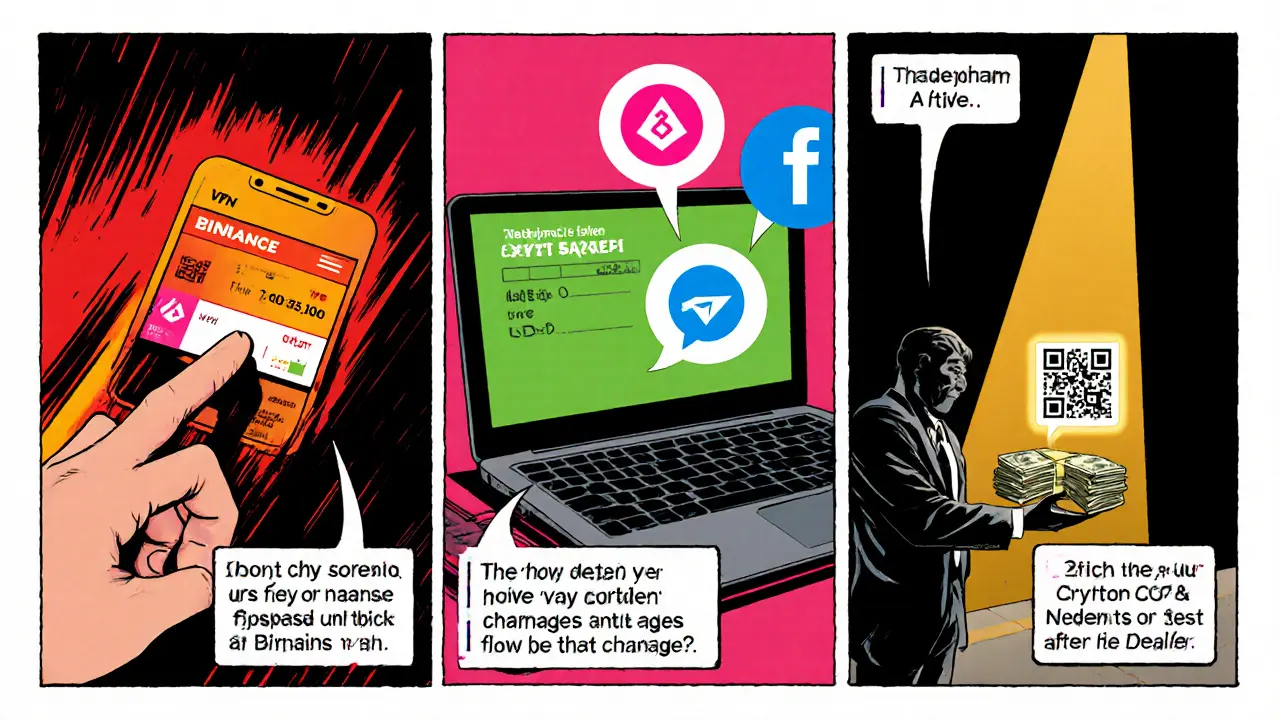
Because official exchanges are shut down, traders turn to VPNs to reach global platforms like Binance is the world’s largest crypto exchange, often accessed via VPN by users in restricted jurisdictions. Once inside, they move funds through a chain of offshore wallets before handing off the crypto to local cash dealers.
- Step 1: Install a reputable VPN and connect to a country where Binance is available.
- Step 2: Transfer fiat to a trusted overseas account, then buy Bitcoin or USDT on Binance.
- Step 3: Use encrypted messaging apps - primarily Telegram is a messaging platform widely used for crypto P2P groups in Myanmar or Facebook is the main social network where informal crypto trading groups operate - to find a local dealer.
- Step 4: Hand over cash to the dealer, who releases the crypto to your offline wallet.
This process creates a thin‑liquidity environment. Large orders can shift prices by double‑digit percentages in minutes, because every trade depends on a handful of trusted intermediaries.
Key Players and Community Hubs
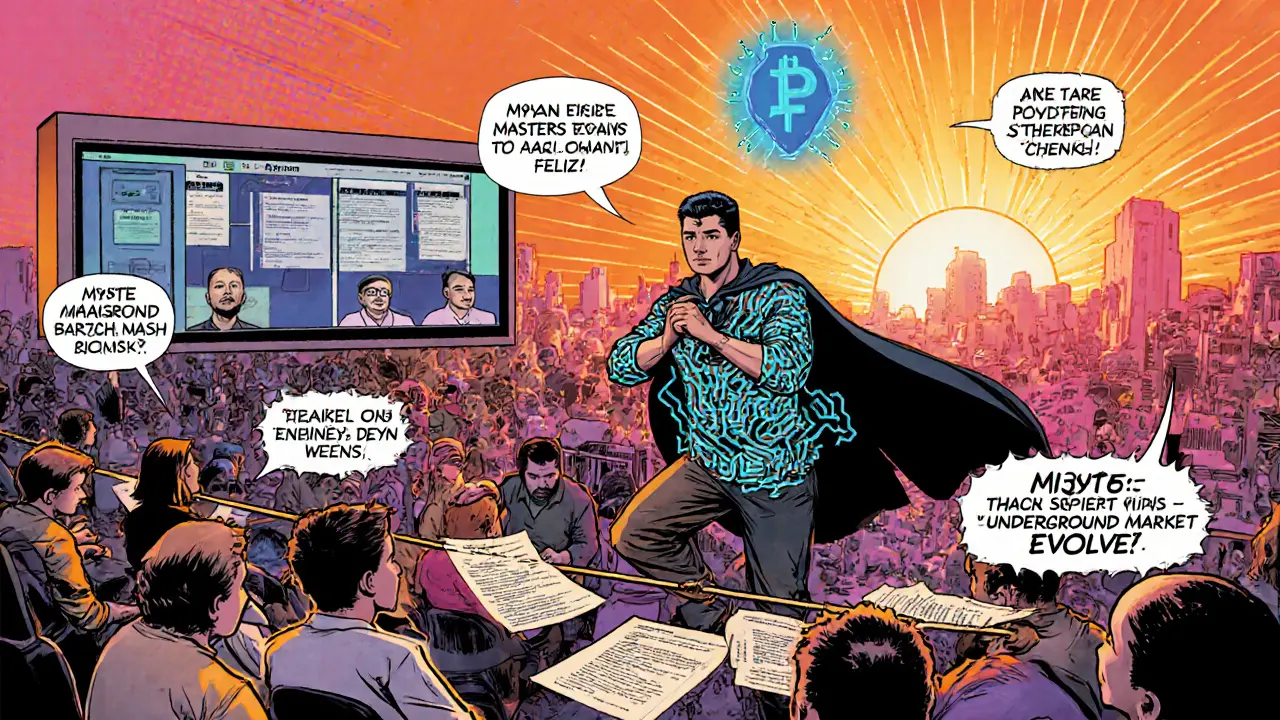
The most visible organized group is the Myan Crypto Masters Community (MCM) is a Burmese‑language community of over 23,000 members that provides education, market signals and dealer referrals. Founded by an individual known as Feliz, MCM runs weekly Zoom‑style workshops, posts step‑by‑step guides on Telegram and even produces TikTok clips that break down complex topics into bite‑size Burmese explanations.
Other informal exchanges pop up on Facebook groups, but they seldom advertise openly. Operators openly admit the risk, saying, “We know we’re taking a risk, but for many people we’re the only option.” Their primary services include:
- Off‑record best‑price quotes for BTC, ETH and stablecoins.
- Escrow‑style handovers using trusted third‑party cash dealers.
- Advice on safe VPN usage and wallet security.
Liquidity, Volatility and Price Swings
Because the market is fragmented, price discovery is local rather than global. A trader trying to sell 5BTC may receive a rate 8‑10% below the Binance spot price, while a smaller 0.1BTC transaction often matches the global price because it can be settled with a single dealer.
These dynamics were starkly visible during the 2022 collapse of a high‑profile scheme that promised 30% weekly returns. Thousands lost money, and without any regulatory recourse, victims were left to rely on community advice for recovery strategies.
Risks, Scams and Legal Consequences
Legal exposure is real. The CBM can freeze bank accounts and prosecute anyone found converting crypto to foreign currency. Penalties range from hefty fines to multi‑year prison sentences. On the ground, users face two primary risks:
- Scams - fake dealer profiles, Ponzi schemes, and phishing bots on Telegram.
- Volatility - thin order books mean a single large trade can wipe out margins in seconds.
Because there is no court or regulator to turn to, the community relies on peer reviews and reputation scores maintained within MCM forums.
Regional Comparison: How Myanmar Stands Out
| Country | Legal status of crypto | Main trading channels | Enforcement approach |
|---|---|---|---|
| Myanmar | Completely illegal (ban since 2020) | VPN‑accessed exchanges, P2P on Facebook/Telegram, underground dealers | Crackdowns on large traders, frequent arrests, asset freezes |
| Thailand | Licensed exchanges, regulated under the Digital Asset Business Act | Registered domestic exchanges, fintech apps | Regulatory licensing, AML reporting, occasional fines |
| Laos | Legal with licensing, but limited enforcement | Local exchanges, cross‑border P2P | Low‑key monitoring, focus on tax compliance |
Myanmar’s environment is the most restrictive in the region, yet its underground scene is arguably the most organized because of community‑driven education and a shared sense of financial resistance.
Future Outlook and Possible Shifts
As of late 2025 there are no signs of the ban loosening. The military government continues to treat crypto as a threat to its monetary sovereignty. However, two forces could alter the landscape:
- Political change - a civilian‑led government might seek to harmonize regulation with neighboring states to attract investment.
- Technological adaptation - projects like the Spring Development Bank of the National Unity Government (operating on the Polygon blockchain) offers USDT‑based remittances and gold‑backed savings, presenting a decentralized alternative that directly challenges the ban.
Until any official shift occurs, the underground market will keep evolving. Users will keep learning VPN tricks, community moderators will keep publishing tutorials, and cash dealers will keep bridging the gap between fiat and crypto - all while walking a legal tightrope.
Frequently Asked Questions
Is it legal to own Bitcoin in Myanmar?
No. The Central Bank of Myanmar classifies all cryptocurrency transactions as illegal under the Foreign Exchange Management Law. Ownership can lead to criminal charges if discovered.
How do people actually buy crypto without a local exchange?
Most use a VPN to access international platforms like Binance, purchase crypto with an offshore bank account, and then sell it to a trusted cash dealer through encrypted messaging apps such as Telegram or Facebook groups.
What are the biggest risks of trading on the underground market?
Legal prosecution, loss of funds to scams, extreme price volatility due to thin liquidity, and no recourse if a deal goes wrong.
Can stablecoins be used safely in Myanmar?
Stablecoins like USDT are popular because they hold value against the US dollar, but they still fall under the ban. Using them risks the same legal penalties as any other crypto.
What role does the Myan Crypto Masters Community play?
MCM provides education in Burmese, shares market tips, and connects newcomers with trusted dealers, acting as the main knowledge hub for underground traders.

Sarah Hannay
October 17, 2025 AT 22:57This is an astonishingly well-researched piece. The way the community has organically built infrastructure under such repression speaks volumes about human ingenuity. I'm deeply moved by the resilience here - not just technical, but moral.
Prabhleen Bhatti
October 18, 2025 AT 22:03Wow!! This is exactly why decentralized finance isn't just about profit-it's about survival!! In India, we see similar underground crypto flows during demonetization chaos, but Myanmar's community-driven model? Pure genius!! MCM's TikTok guides? That's next-level grassroots education!!
Elizabeth Mitchell
October 19, 2025 AT 15:03I just read this on my lunch break and couldn't stop thinking about it. It’s wild how people create systems when the system itself is working against them.
Chris Houser
October 20, 2025 AT 07:24Real talk - this is what financial inclusion looks like when institutions fail. No banks? No problem. People built their own. The fact that they use Telegram and Facebook for escrow is genius. Simple, accessible, effective. This isn't crypto bros - this is everyday people keeping their families alive.
William Burns
October 21, 2025 AT 01:38One must question the intellectual rigor behind glorifying criminal activity under the guise of 'resilience.' The Central Bank's stance is not arbitrary - it is a sovereign imperative to preserve monetary integrity. To romanticize this underground economy is to ignore the foundational principles of economic order.
Ashley Cecil
October 21, 2025 AT 04:55It is deeply concerning that this article fails to emphasize the illegality of these transactions. The Central Bank of Myanmar has clearly defined the legal parameters. To present this as a 'lifeline' without unequivocally condemning the violation of law is irresponsible journalism.
John E Owren
October 21, 2025 AT 06:16I’ve seen this pattern before - when people are pushed to the edge, they find ways to survive. It’s not about crypto. It’s about dignity. The fact that they’ve built trust networks without any formal institutions is impressive. I hope someone documents this properly before it disappears.
Jennifer Rosada
October 22, 2025 AT 01:08Let’s be honest - this isn't freedom. It's chaos with a side of optimism. People are risking prison for a volatile digital asset that can vanish in seconds. And you call this innovation? It’s desperation dressed up as rebellion.
adam pop
October 22, 2025 AT 17:54They’re using Telegram? Of course they are. The government is monitoring everything. This whole thing is a psyop. Crypto isn’t banned because of money control - it’s banned because the regime knows Bitcoin could expose their offshore accounts. This is a cover-up.
Dimitri Breiner
October 23, 2025 AT 17:45Exactly what I’ve been saying for years - regulation doesn’t stop innovation, it just pushes it underground. Myanmar’s model is actually a blueprint for how crypto can thrive in oppressive environments. MCM’s educational approach? That’s the real win here. Not the tech - the community.
LeAnn Dolly-Powell
October 24, 2025 AT 11:54🥹 This made me cry. People are literally risking everything just to have control over their money. MCM’s TikTok guides? That’s hope in action. We need more stories like this - not just about tech, but about humanity.
Anastasia Alamanou
October 25, 2025 AT 02:37It’s fascinating how the structure mirrors decentralized governance models - no central authority, reputation-based trust, peer validation. MCM functions like a DAO without the token. The real innovation isn’t the tech - it’s the social architecture built under duress.
Rohit Sreenath
October 25, 2025 AT 20:25People think crypto is about money. No. It's about power. And power belongs to those who control the narrative. The regime fears this because they know truth cannot be contained. This is not a market. It is a revolution.
Sam Kessler
October 26, 2025 AT 02:36Let’s not pretend this is organic. The entire ecosystem is a front for money laundering and sanctions evasion. The so-called 'community' is just a veneer for criminal networks using propaganda to legitimize illicit activity. Anyone who praises this is either naive or complicit.
Steve Roberts
October 26, 2025 AT 11:22Wait - you’re saying this works? Then why isn’t everyone doing it? If it’s so easy and effective, why is it still underground? Because it’s dangerous, unreliable, and full of fraud. This isn’t a solution - it’s a symptom of collapse.
Richard Williams
October 27, 2025 AT 03:06Hey - I just want to say thank you for writing this. I’ve spent years studying financial exclusion in conflict zones, and this is one of the clearest, most human examples I’ve seen. You didn’t just report facts - you showed dignity. Keep going.