
When the EU’s Markets in Crypto-Assets Regulation (MiCA) fully took effect on December 30, 2024, it didn’t just change how crypto companies operate-it rewrote the rules for who can even stay in the game. If you’re running a crypto exchange, wallet service, or stablecoin issuer in Europe, you’re now under the same legal microscope as a bank. And the penalties for slipping up? They’re real, immediate, and across the entire bloc.
What MiCA Actually Does
MiCA isn’t a suggestion. It’s law. And it applies to every Crypto Asset Service Provider (CASP) that touches EU users-no matter where the company is based. That means a U.S.-based exchange that lets a German citizen trade Bitcoin must now follow EU rules. The regulation forces these providers to get licensed, disclose risks, protect user funds, and stop illegal activity before it happens.
At its core, MiCA brings crypto under the same rules as traditional finance. It requires companies to have clear governance, audit trails, and systems to detect suspicious behavior. But it goes further: it bans unbacked stablecoins from being issued in the EU. Only those with real, liquid reserves-1:1 backed and audited daily-can operate. And even then, they’re capped at €200 million in daily transactions. Why? Because the European Central Bank sees unregulated stablecoins as a threat to monetary stability.
The Transfer of Funds Regulation (TFR): The Real Enforcement Tool
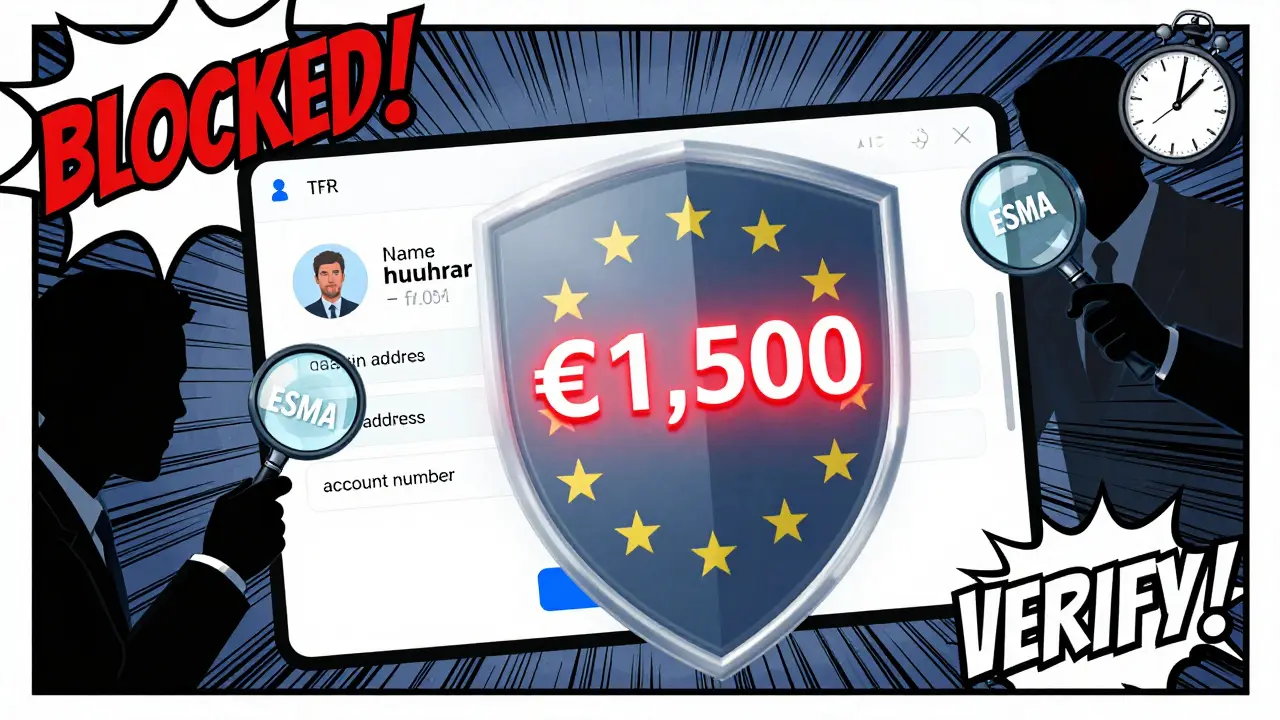
If MiCA sets the rules, the Transfer of Funds Regulation (TFR) is the hammer. Starting December 30, 2024, every crypto transfer over €1,000 must carry full sender and recipient data-name, account number, address-just like a bank wire. No exceptions. No loopholes. No "privacy coins" hiding behind obfuscation.
This is the strictest "travel rule" in the world. Even if you’re sending €1,500 from Estonia to Poland, your wallet provider must verify both parties. If they can’t, the transaction gets blocked. That’s not a technical hiccup-it’s a legal requirement. And there’s no grace period. Companies that didn’t upgrade their systems by January 1, 2025, are already in violation.
For users, this means less anonymity. For businesses, it means rebuilding entire transaction pipelines. Many small providers still struggle with this. Some don’t have the infrastructure to collect, store, and transmit personal data securely. Others don’t understand that even peer-to-peer platforms can be classified as CASPs under MiCA. Ignorance isn’t a defense.
How Sanctions Are Enforced
The EU doesn’t just write rules-it enforces them. The European Securities and Markets Authority (ESMA) coordinates with national regulators like Germany’s BaFin or France’s AMF. If a CASP fails compliance, the consequences are swift:
- Fines up to 5% of annual turnover
- Immediate suspension of services
- Blacklisting from the EU market
- Public naming and shaming on ESMA’s official site
There’s no "one country" exception. Once you’re banned in one EU state, you’re banned everywhere. This is the passporting system turned into a trap: get licensed in Lithuania? Fine. But if you break rules in Spain, your license evaporates across all 27 countries.
And it’s not just about money laundering. MiCA also targets market manipulation, insider trading, and unlicensed token issuance. If a crypto firm promotes a token without proper documentation-or if its CEO trades on non-public info-it’s a violation. These aren’t theoretical risks. In early 2025, a Belgian crypto firm was fined €1.2 million for promoting a meme coin with false claims about its backing. The EU didn’t wait. They acted.
Other Rules That Stack On Top
MiCA doesn’t work alone. It’s part of a three-layer system:
- DORA (Digital Operational Resilience Act) - From January 17, 2025, all CASPs must prove they can survive cyberattacks. That means regular penetration tests, backup systems, and third-party vendor oversight. If your cloud provider gets hacked and your users lose access? You’re liable.
- CARF (Crypto-Asset Reporting Framework) - Starting in 2026, CASPs must report user transaction data to national tax authorities. Think of it as crypto’s version of Form 1099. Non-compliance? Fines, audits, and possible criminal charges.
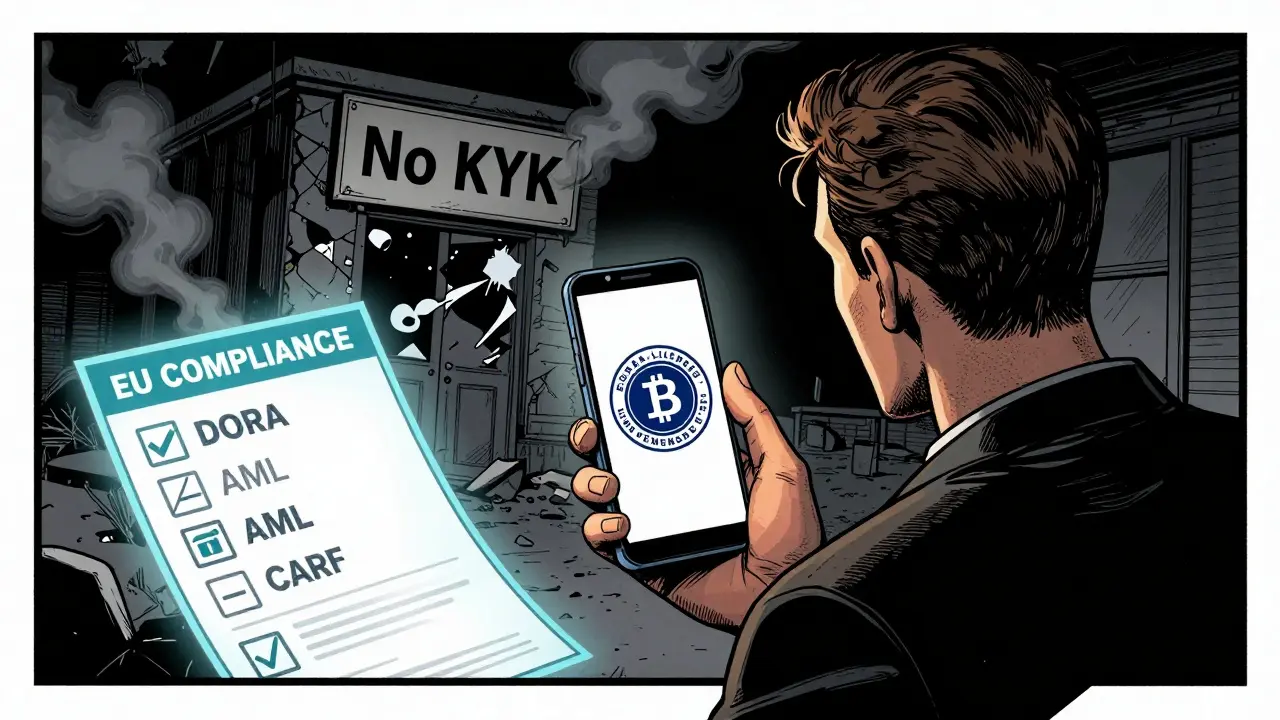
- Existing AML Directives - MiCA layers on top of the EU’s 6th Anti-Money Laundering Directive. That means you still need KYC, transaction monitoring, and STR reporting. But now, the rules are more precise, and the penalties are higher.
Together, these create a regulatory web that’s hard to escape. You can’t just use one tool. You need a full stack: KYC software, transaction monitoring, data encryption, audit logs, and tax reporting systems-all working in sync.
What About U.S. Crypto Companies?
The U.S. took a different path. In July 2025, the GENIUS Act passed, creating a flexible, innovation-friendly framework for stablecoins. It doesn’t ban anything. It doesn’t cap transaction volumes. It lets firms self-certify under federal oversight. The SEC calls it "Project Crypto"-a push to bring crypto innovation home.
But here’s the catch: if your U.S. company serves EU customers, you still must follow MiCA. The EU doesn’t care if you’re compliant in the U.S. If you want access to 450 million European consumers, you play by EU rules. That’s why major U.S. exchanges like Coinbase and Kraken spent over $200 million in 2024 to set up EU subsidiaries, hire local compliance teams, and rebuild their systems.
It’s not about geography. It’s about market access. And the EU is making it clear: no shortcuts.
Real-World Challenges for Businesses
Companies are struggling. Many small providers still use legacy systems that can’t handle TFR data. Some don’t know how to classify their tokens. Others think "we’re just a wallet" and don’t realize they’re now a CASP under MiCA.
There’s also confusion around the 18-month grandfathering period. While MiCA allows existing providers to continue operating while applying for licenses, not all EU countries offer the full 18 months. In Poland, it’s 6 months. In the Netherlands, it’s 12. That creates a patchwork of deadlines, making cross-border compliance a nightmare.
And users? They’re caught in the middle. Some wallets stopped supporting certain tokens. Others now require ID verification just to send €50. The EU’s warnings about "limited protection" aren’t marketing-they’re reality. If your provider isn’t licensed, you have no legal recourse if they vanish.
What Happens Next?
By the end of 2026, CARF will be fully active. Tax authorities will have access to crypto transaction data across the bloc. That means crypto income is no longer invisible. The days of filing "I didn’t know" are over.
The European Central Bank is already moving toward a digital euro. They see crypto as a risk, not a revolution. And MiCA? It’s their firewall.
For businesses: if you’re not compliant, you’re already behind. There’s no more time to wait. The EU isn’t going to soften its stance. The rules are clear. The deadlines passed. The enforcement is here.
For users: know who you’re dealing with. Only use providers licensed by ESMA. Check their status on the official EU register. If they won’t show you their license, walk away.
This isn’t about banning crypto. It’s about controlling it. And the EU is winning that battle-not by force, but by structure, enforcement, and relentless consistency.
Do I need a license if I’m just buying crypto in the EU?
No. MiCA only applies to businesses that provide services-like exchanges, wallets, or token issuers. If you’re an individual buying or holding crypto, you don’t need a license. But your provider does. If they’re not licensed, your funds aren’t protected under EU law.
What happens if I send crypto from outside the EU to someone in the EU?
The transaction will be blocked if the recipient’s provider can’t verify your identity. Even if you’re using a non-EU wallet, the EU-based recipient’s platform must comply with TFR. That means if your wallet doesn’t collect your name and address, the transfer won’t go through. There’s no way around it.
Are privacy coins like Monero or Zcash banned in the EU?
They’re not explicitly banned, but they’re effectively unusable. Because TFR requires full sender and recipient data, privacy coins can’t be processed by licensed CASPs. If a provider tries to support them, they risk losing their license. So while not illegal, they’re functionally excluded from the EU market.
Can I still use decentralized exchanges (DEXs) in the EU?
Technically yes-but only if you’re not interacting with a registered CASP. If a DEX has a company behind it, collects fees, or offers fiat on-ramps, it must be licensed. Many DEXs are trying to restructure as purely peer-to-peer platforms with no legal entity. But regulators are watching closely. If they find any centralized control, they’ll shut it down.
What’s the difference between MiCA and the U.S. GENIUS Act?
MiCA is a top-down, rule-based system: if you do X, you must do Y. The GENIUS Act is bottom-up: if you meet certain criteria, you can operate with flexibility. The EU wants control. The U.S. wants innovation. But if you serve EU users, you follow MiCA-no matter where you’re based.
Anthony Marshall
March 12, 2026 AT 09:06Douglas Anderson
March 14, 2026 AT 01:14vasantharaj Rajagopal
March 16, 2026 AT 01:08Lindsay Girvan
March 16, 2026 AT 23:57karan narware
March 18, 2026 AT 00:10Anshita Koul
March 18, 2026 AT 10:54PIYUSH KOTANGALE
March 19, 2026 AT 13:54Zephora Zonum
March 20, 2026 AT 23:10Jennifer Pilot
March 22, 2026 AT 08:06Craig Gregory
March 22, 2026 AT 11:16vishnu mr
March 23, 2026 AT 12:59Grace van Gent-Korver
March 24, 2026 AT 01:17Alex Thorn
March 24, 2026 AT 05:59Douglas Anderson
March 24, 2026 AT 22:19Allison Davis
March 25, 2026 AT 00:49