
Why Malta Still Matters for Crypto Businesses in 2025
If you’re thinking about launching a crypto business in Europe, Malta isn’t just a pretty island with great weather-it’s one of the few places where you can get a legally recognized license that works across the entire EU. Since 2018, Malta has built one of the clearest, most detailed regulatory systems for digital assets in the world. But things changed in 2024. With the full rollout of the EU’s Markets in Crypto-Assets (MiCA) regulation, Malta didn’t just follow along-it rewrote its own rules to match. Now, if you get a license in Malta, you’re not just compliant locally. You’re also ready to operate anywhere in the EU.
The Four License Classes and What They Allow
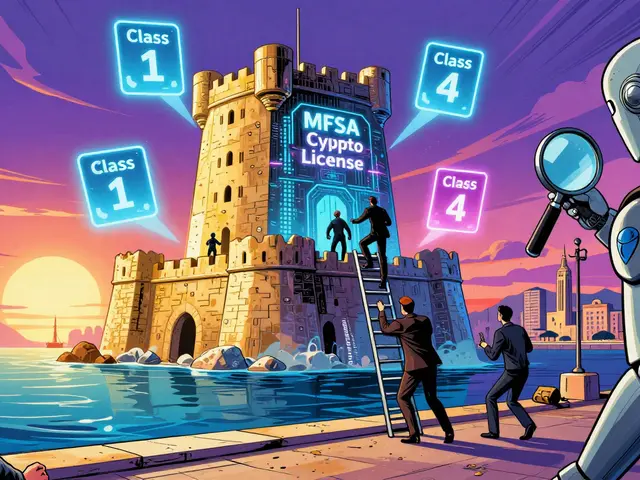
Malta doesn’t have one-size-fits-all crypto licenses. There are four distinct classes, each designed for different types of businesses. Choosing the wrong one can mean wasted time, money, and a rejected application.
- Class 1: For advisory firms, DeFi protocol developers, and crypto analysts. Minimum capital: €50,000 (or €25,000 + professional indemnity insurance). You can’t hold client funds or trade on your own account.
- Class 2: For custody providers, brokers, and OTC desks. Requires higher capital, stricter AML controls, and proof you can securely store digital assets. This is the most common license for firms that don’t run exchanges but still handle client assets.
- Class 3: For asset managers and investment firms dealing with tokenized securities. Requires detailed risk management systems, regular audits, and full transparency on portfolio holdings.
- Class 4: For cryptocurrency exchanges, fiat-to-crypto platforms, and ICO/ITO issuers. Highest capital requirement (€1 million minimum), mandatory external audits, and systems capable of handling 10,000+ daily transactions. This is the most expensive and heavily scrutinized license.
Most startups begin with Class 1 or 2. Only serious exchanges or trading platforms go for Class 4. The MFSA doesn’t let you jump straight to Class 4 unless you can prove you have the infrastructure, team, and financial backing to handle it.
What You Must Do Before Applying
Getting a license isn’t about filling out a form. It’s about proving you’re a real, stable, and compliant business. Here’s what you need before you even submit an application:
- Incorporate in Malta: You must register a legal entity with the Malta Business Registry. It can’t be a foreign company operating remotely. You need a local company with a registered office.
- Appoint a local Compliance Officer: This person must be approved by the MFSA and physically based in Malta. They’re responsible for daily AML monitoring and reporting to the Financial Intelligence Analysis Unit (FIAU).
- Get criminal record checks: All directors, shareholders with over 10% ownership, and key personnel must provide police certificates issued no more than three months before submission. Expired or missing documents are an automatic rejection.
- Write a detailed business plan and whitepaper: The MFSA doesn’t want buzzwords. They want hard numbers: projected revenue, user growth, transaction volume, cost structure, and a clear path to profitability. Vague ideas like “we’ll be the next Binance” get tossed.
- Prove your capital source: Where did the money come from? Bank statements, investor agreements, or loan documents must be provided. If you’re using crypto to fund your company, you’ll need a clear audit trail showing how it was converted to fiat.
- Implement AML/KYC systems: Your software must be able to screen users against global sanctions lists, monitor for suspicious activity in real time, and generate reports for FIAU. Off-the-shelf tools aren’t enough-you need customization and testing logs.
The Application Process: Timeline and Pitfalls
The entire process takes 4 to 6 months. That’s not a typo. Many companies think they can speed it up. They can’t.
Here’s how it breaks down:
- Weeks 1-2: Gather documents. This includes everything from shareholder IDs to software architecture diagrams.
- Weeks 3-4: Incorporate your company in Malta. This step alone can take 10-14 days if you don’t have a local agent.
- Weeks 5-8: Pre-application review with your MFSA-approved VFA agent. This is your last chance to fix mistakes before submission.
- Months 2-6: MFSA review. They’ll interview your team, audit your systems, and ask for additional documents. Expect at least two rounds of revisions.
Here’s what kills applications: incomplete criminal record certificates, outdated financial models, and lack of local personnel. According to MFSA’s 2024 report, 78% of rejections were due to weak AML documentation or unrealistic business models. One company applied with a plan to serve 50,000 users in six months but had no marketing budget. They got rejected in 11 days.

The Hidden Costs You Can’t Ignore
License fees are just the tip of the iceberg. Here’s what a typical Class 2 license costs in the first year:
- Company incorporation: €2,500-€5,000
- Legal and consulting fees (Maltese law firm): €25,000-€45,000
- Local director and compliance officer salary: €60,000-€80,000/year
- Physical office space (minimum requirement): €15,000-€25,000/year
- AML software and setup: €10,000-€20,000
- Annual audit (mandatory): €15,000+
- Staff AML training (€350 per person): €2,000-€10,000 depending on team size
That’s a minimum of €120,000 just to get started. And you haven’t even begun trading yet.
One exchange founder on Reddit shared that they budgeted €70,000 for local staffing-but ended up paying €85,000 because they had to hire two people full-time to meet MFSA’s “local presence” rule. That rule means every key function-compliance, finance, customer support-must be handled by people physically in Malta. Remote workers don’t count.
Why So Many Companies Use the Regulatory Sandbox
Before applying for a full license, most smart operators test their model in Malta’s FinTech sandbox. It’s free, and it lets you operate under limited conditions for up to 12 months while you refine your systems.
According to CryptoSlate’s 2024 survey, 41% of successful applicants used the sandbox first. The biggest benefit? You get direct feedback from MFSA regulators before you submit your formal application. One DeFi startup used the sandbox to fix their KYC flow after three failed user tests. They got approved on their first full application.
The sandbox isn’t a shortcut-it’s a safety net. Skipping it increases your risk of rejection by over 60%.
How Malta Compares to Other EU Countries
Malta isn’t the cheapest, and it’s not the fastest. But it’s one of the most predictable.
| Country | Avg. Approval Time | Minimum Capital (Class 2) | Local Staff Requirement | MiCA Passporting |
|---|---|---|---|---|
| Malta | 4-6 months | €125,000 | Yes | Yes |
| Estonia | 2-3 months | €12,000 | No (remote allowed) | No |
| Germany | 6-9 months | €100,000 | Yes | Yes |
| Lithuania | 3-5 months | €125,000 | Yes | Yes |
| France | 5-7 months | €125,000 | Yes | Yes |
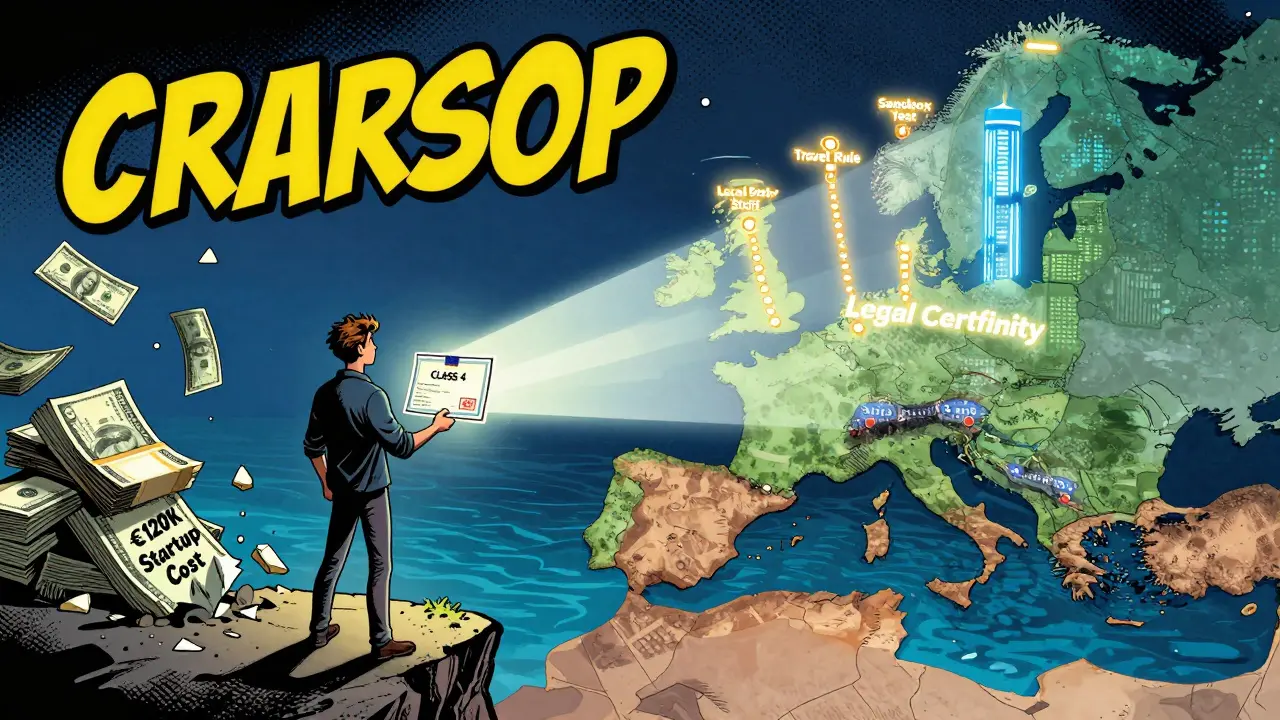
Estonia is cheaper and faster, but you can’t operate across the EU without separate licenses in each country. Germany and France have higher barriers and longer waits. Malta sits in the middle: higher cost than Estonia, faster than Germany, and the only one that gives you full EU access right away.
Who Should Apply for a Malta License?
Malta is ideal for businesses that:
- Plan to serve EU customers long-term
- Have at least €150,000 in startup capital
- Can commit to maintaining a physical presence in Malta
- Want legal clarity and EU-wide market access
It’s not for:
- Startups with under €100,000 in funding
- Teams that want to run everything remotely
- Businesses that can’t afford ongoing compliance costs of €100,000+/year
- Companies focused only on non-EU markets (like Asia or the U.S.)
As of Q1 2025, Malta has 147 licensed crypto firms-more than Gibraltar, Switzerland, and most EU countries. And 63% of those are exchanges. If you’re building a trading platform, Malta’s track record speaks for itself.
What’s Coming in 2025 and Beyond
Malta is preparing for the next wave of regulation. By Q3 2025, all licensed entities must comply with the EU’s Travel Rule, which requires sharing sender and recipient data on transactions over €1,000. That means your tech stack needs to support real-time data sharing with other VASPs-something most small exchanges still can’t do.
Fitch Ratings predicts that by 2027, companies making less than $5 million annually will struggle to stay profitable under these costs. Many will either shut down, merge, or move to lower-cost jurisdictions like Portugal or Georgia.
But for those who can afford it, Malta remains the safest bet in Europe. The MFSA is strict, but they’re fair. They don’t change rules overnight. They give you time to adapt. And if you get approved, you get something rare: legal certainty in a chaotic industry.
Final Thoughts: Is It Worth It?
Getting a crypto license in Malta is expensive, slow, and demanding. But if you’re serious about operating in Europe, there’s no better alternative. You’re not just buying a license-you’re buying access to the entire EU market, legal protection, and a reputation that institutions trust.
Most businesses that fail in Malta do so because they underestimate the cost, the time, or the need for local presence. If you’re ready to invest in real infrastructure-not just code and marketing-you’ll find Malta’s framework gives you more than compliance. It gives you credibility.
Can I apply for a Malta crypto license without being physically in Malta?
No. You must incorporate a legal entity in Malta and have key roles-like the Compliance Officer, local director, and finance staff-physically based on the island. Remote work is not accepted for compliance-critical functions. You can hire remote developers, but the people managing AML, reporting, and client funds must be in Malta.
How long does a Malta crypto license last?
A VFA license doesn’t expire, but it must be renewed annually. The MFSA requires you to submit updated financial statements, AML reports, and proof of continued capital adequacy each year. Failure to meet these requirements can lead to suspension or revocation.
Can I use my existing company from another country to apply?
No. You must create a new legal entity registered with the Malta Business Registry. You can transfer assets or intellectual property to the new company, but the license application must be submitted under a Maltese-registered company. Foreign entities cannot apply directly.
What happens if my application is rejected?
You can reapply, but you’ll need to fix the exact issues the MFSA identified. Common reasons for rejection include outdated criminal record certificates, incomplete business plans, or insufficient capital proof. There’s no appeal process, but you can request feedback from the MFSA’s Innovation Hub. Most successful applicants reapply after 3-6 months of corrections.
Do I need to pay taxes in Malta if I get a crypto license?
Yes. Malta taxes corporate income at 35%, but through its refund system, the effective rate for foreign shareholders can be as low as 5%. You’ll also pay VAT on services, and employees must contribute to social security. Tax planning is essential-many firms use Malta’s holding company structure to reduce liabilities, but this requires legal advice.
Can I apply for a Class 4 license right away?
Technically yes, but the MFSA will only approve it if you prove you have the infrastructure, team, and capital to handle high-volume trading. Most applicants start with Class 2 and upgrade after 12-18 months of compliance. Jumping straight to Class 4 without a track record increases your risk of rejection by over 70%.
Tisha Berg
December 9, 2025 AT 23:25Nelson Issangya
December 11, 2025 AT 08:22Joe West
December 12, 2025 AT 14:46nicholas forbes
December 13, 2025 AT 04:50Cristal Consulting
December 14, 2025 AT 21:56Uzoma Jenfrancis
December 15, 2025 AT 10:16Mairead Stiùbhart
December 16, 2025 AT 22:02Doreen Ochodo
December 16, 2025 AT 23:10Yzak victor
December 18, 2025 AT 17:14Holly Cute
December 20, 2025 AT 04:06Josh Rivera
December 20, 2025 AT 21:31Neal Schechter
December 21, 2025 AT 04:40Madison Agado
December 21, 2025 AT 13:46Billye Nipper
December 22, 2025 AT 00:47Roseline Stephen
December 22, 2025 AT 10:57Richard T
December 22, 2025 AT 16:37