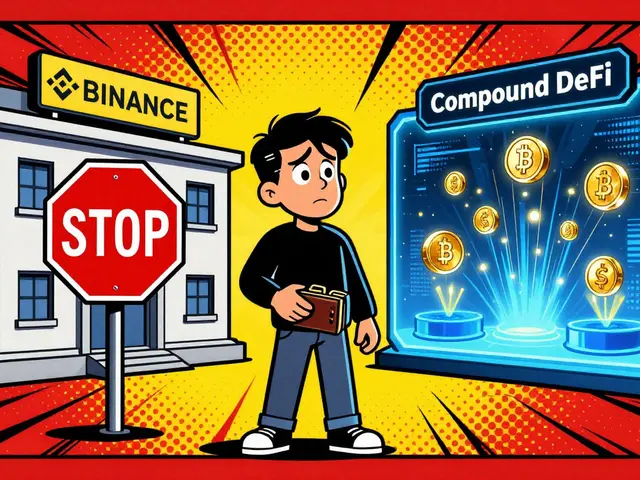
There is a common confusion in the crypto space that can cost you time and money. You might be looking for a "Compound crypto exchange" to buy Bitcoin or Ethereum, only to find yourself staring at a dashboard full of lending pools and governance tokens instead. Here is the hard truth: Compound is not a centralized cryptocurrency exchange like Binance or Coinbase.
If you are expecting to trade stocks for crypto, deposit fiat currency via bank transfer, or speak to customer support on a phone call, you are in the wrong place. Compound is a decentralized finance (DeFi) protocol built on the Ethereum blockchain. Its primary function is not trading assets against each other, but rather allowing users to lend their crypto to earn interest or borrow crypto by providing collateral. Understanding this distinction is critical before you connect your wallet.
What Exactly Is Compound Protocol?
To understand why there is no "exchange" interface, we need to look at what Compound actually does. Launched in 2018, Compound is an algorithmic, autonomous interest rate protocol built for developers, to unlock a universe of open financial applications. It operates without a central company managing your funds. Instead, smart contracts handle everything.
Think of it as a peer-to-pool lending market. When you deposit assets into Compound, you aren't lending them to a specific person. You are adding liquidity to a large pool. Borrowers then pull from this pool. The interest rates you earn or pay are determined automatically by the supply and demand for those specific assets. If everyone wants to borrow USDC, the borrowing rate goes up, which means the interest rate for lenders also increases.
This model stands in stark contrast to centralized exchanges (CEXs). On a platform like Kraken or Coinbase, the company holds your keys, manages the ledger, and sets the fees. On Compound, you hold your own keys, and the code dictates the rules. This brings us to the core value proposition: transparency and control, albeit with higher complexity for the average user.
How Compound Works: Deposits, Loans, and cTokens
The mechanics of Compound are straightforward once you grasp the concept of cTokens. When you deposit an asset, such as DAI or ETH, into the Compound protocol, you receive a corresponding cToken in return. For example, depositing ETH gives you cETH. Deposit DAI, and you get cDAI.
These cTokens are crucial because they represent your share of the underlying asset pool plus the accrued interest. As you earn interest, the exchange rate between your cToken and the underlying asset increases. You don't see a balance update in real-time; instead, your cToken becomes worth more of the underlying asset over time. To claim your earnings, you simply redeem your cTokens for the underlying asset.
Borrowing works differently. To borrow, you must first deposit collateral. Compound uses an over-collateralization model to protect lenders. This means you must deposit more value than you intend to borrow. For instance, if you want to borrow $1,000 worth of USDC, you might need to deposit $1,500 worth of ETH as collateral. The exact ratio depends on the "Collateral Factor" set by the protocol for each asset.
- Liquidity: Assets available for lending and borrowing include major cryptocurrencies like ETH, WBTC, USDC, DAI, and USDT.
- Interest Rates: Variable rates change based on utilization. High utilization leads to higher rates for both borrowers and lenders.
- Collateral Factors: Not all assets have the same borrowing power. Stablecoins usually have higher collateral factors than volatile assets like ETH.
Fees and Costs: What Will It Cost You?
One of the biggest misconceptions about DeFi is that it is free. While there are no traditional "trading fees" or "withdrawal fees" charged by a company, the costs can add up quickly if you are not careful. Since Compound lives on the Ethereum blockchain, every interaction requires a gas fee.
Gas fees are payments made to Ethereum validators to process your transaction. During times of high network congestion, these fees can spike significantly. A simple deposit or withdrawal might cost anywhere from $5 to $50 or more in ETH, depending on network conditions. For small transactions, this can eat into your profits entirely.
In addition to gas, Compound charges a "reserve factor." This is a portion of the interest earned by lenders that goes to the Compound treasury. For most assets, this reserve factor is around 10%. This means if you earn 10% interest on your lent assets, roughly 1% goes to the protocol to fund development and governance incentives, and you keep the remaining 9%.
| Cost Type | Compound (DeFi) | Centralized Exchange (e.g., Coinbase) |
|---|---|---|
| Trading Fees | N/A (No trading pairs) | 0.5% - 3.99% per trade |
| Network Fees | Ethereum Gas (Variable, often high) | Usually none for internal transfers |
| Withdrawal Fees | On-chain gas fee only | Fixed fee per coin (e.g., 0.001 BTC) |
| Spread | Minimal (Market-driven) | Often hidden in the price quote |

Governance and the COMP Token
Compound is not just a lending protocol; it is a Decentralized Autonomous Organization (DAO). This means the community governs the platform through the COMP token, which serves as the governance token for the Compound protocol. Holding COMP allows you to vote on proposals that affect the future of the protocol.
What kind of decisions are made? Proposals can include changing interest rate models, adjusting collateral factors for new assets, updating the reserve factor, or even integrating with other DeFi protocols. The COMP token was introduced in 2020, marking a significant shift from a purely utility-based protocol to one with a strong economic incentive structure.
Initially, COMP tokens were distributed to active users of the protocol to encourage participation. Today, holders can stake their COMP to participate in governance. This creates a feedback loop where those with a financial stake in the protocol's success help steer its direction. However, governance participation requires technical knowledge and time, which remains a barrier for many retail users.
Safety and Risks: Is Your Money Safe?
Security is paramount in DeFi. Unlike centralized exchanges that can go bankrupt or freeze withdrawals (as seen with FTX), Compound relies on the security of the Ethereum blockchain and its smart contracts. The protocol has undergone multiple audits by leading security firms like Trail of Bits and OpenZeppelin. To date, it has maintained a strong track record with no major exploits resulting in significant loss of user funds.
However, "safe" in DeFi does not mean "risk-free." There are several layers of risk you must consider:
- Smart Contract Risk: Although audited, bugs can still exist. If a vulnerability is found, exploiters could drain the protocol. This is a theoretical risk present in all DeFi.
- Impermanent Loss / Liquidation Risk: If you are borrowing, and the value of your collateral drops below the required threshold, your position will be liquidated. This means your collateral is sold off to repay the loan, often at a penalty. You lose your principal.
- Oracle Risk: Compound relies on Chainlink oracles to determine the price of assets. If an oracle fails or provides incorrect data, it could lead to improper liquidations or insolvency in the pool.
- User Error: Because you control your own keys, if you send funds to the wrong address or approve a malicious contract, there is no customer support to reverse the transaction.
For context, Compound handles billions of dollars in Total Value Locked (TVL). At its peak during the 2021 bull run, TVL exceeded $4 billion. As of mid-2026, it remains one of the top lending protocols by volume, indicating sustained trust from institutional and retail players alike.
Who Should Use Compound?
Compound is not for everyone. If you are a beginner who just wants to buy some Bitcoin and hold it, a centralized exchange like Coinbase or Kraken is far easier and cheaper. You should use Compound if you fall into one of these categories:
- Yield Seekers: You want to earn passive income on your idle crypto assets. Lending stablecoins like USDC or DAI often yields competitive annual percentage rates (APRs).
- Leveraged Traders: You want to borrow against your holdings to increase exposure without selling your long-term assets. For example, borrowing USDC against ETH to buy more ETH.
- DeFi Developers: You are building an application that needs access to deep liquidity and reliable lending infrastructure.
- Privacy Advocates: You prefer non-custodial solutions where you retain control of your private keys at all times.
Alternatives to Consider
While Compound is a pioneer, it is not alone. The DeFi lending landscape is crowded with competitors offering similar services, sometimes with lower fees or different features.
Aave is the most direct competitor. Like Compound, it is a non-custodial liquidity protocol. Aave offers additional features like flash loans and variable/stable borrowing rate options, giving users more flexibility. Many users compare the two daily to see which offers better APY for their specific asset.
MakerDAO is another giant in the space, though it functions slightly differently. It focuses primarily on generating the DAI stablecoin through collateralized debt positions (CDPs). While less focused on general-purpose lending, it is deeply integrated into the broader DeFi ecosystem.
If you are looking for a true "exchange" experience with lower fees than centralized platforms, you might consider Decentralized Exchanges (DEXs) like Uniswap or SushiSwap. These allow you to swap tokens directly from your wallet, but they do not offer lending or borrowing capabilities.
Is Compound a centralized or decentralized exchange?
Compound is neither. It is a decentralized lending protocol. It is not an exchange because you cannot trade one cryptocurrency for another directly on the platform. It is decentralized because it runs on smart contracts without a central authority.
Can I buy Bitcoin on Compound?
No. You cannot buy Bitcoin on Compound. You can only lend or borrow assets that are already supported by the protocol, such as Wrapped Bitcoin (WBTC). To get WBTC, you would typically buy it on a centralized exchange or a decentralized exchange like Uniswap first.
What happens if I get liquidated on Compound?
If the value of your collateral drops too low relative to your loan, your position is liquidated. Liquidators will buy your collateral at a discount to repay your debt. You lose your collateral, and potentially a portion of its value due to the liquidation penalty.
Are there monthly fees for using Compound?
There are no subscription fees. However, you pay Ethereum gas fees for every transaction (deposit, withdraw, borrow, repay). Additionally, a small percentage of interest earned (the reserve factor) goes to the protocol treasury.
Is Compound safe for beginners?
It carries higher risks than centralized exchanges due to smart contract vulnerabilities and user error. Beginners should start with small amounts and ensure they understand how gas fees and liquidations work before committing significant capital.